
How to Play Skins in Golf: Rules, Carryovers and Payouts
In skins, every hole has a value, and the player with the lowest score on that hole wins it, but only if nobody ties them. If two or more players tie for low, nobody wins and the skin carries over. The next player to win a hole outright collects that hole plus everything that piled up behind it.
That covers the core game. Most of the arguments come from what it leaves out: what a skin is worth, what happens to skins still unclaimed after 18, and how handicaps fit in. Your group should settle all of that on the first tee.
Skins goes back decades. It became widely popular after the made-for-TV Skins Game started in the 1980s. Depending on where you play, you may hear it called cats, skats or syndicates.
On this page
Basic skins rules
- Agree on the format. Decide on gross or net, carryovers or none, validation or none, the stake, and what happens to leftover skins.
- Collect the money. Get it before you tee off, not after.
- Play stroke play. Everyone holes out, or picks up at an agreed maximum.
- Compare scores after each hole. One player alone with the low score wins the skin. Any tie for low means no winner.
- Keep a ledger. Track who won which skins and how many are currently carried.
Ties only matter at the top. If scores are 4, 4, 5 and 6, the two 4s cancel each other out. The 5 doesn't win just because it's the best score that isn't tied.
Carryovers: how skins build
When a hole is tied, its skin moves to the next hole. That hole is then worth two skins. Tie again and it's worth three. A string of tied holes turns one routine par into the biggest moment of the day. When the pro Skins Game returned in 2025, a single shot on a par 3 collected four carried-over skins.
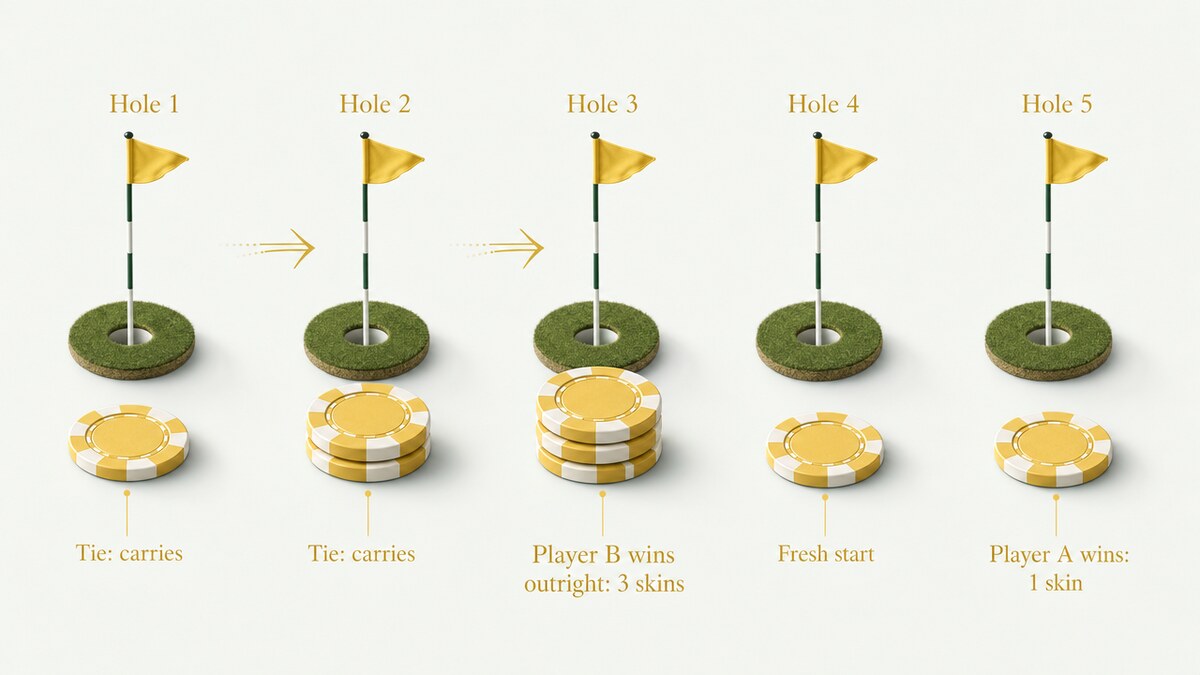
Some groups play without carryovers. A tied hole is simply dead and its money stays in the pot to be shared at the end. This is the norm for big field games, covered below.
Validation (back it up)
Validation makes a winner prove the win. If you collect carried-over skins, you have to at least match the low score on the next hole to keep them. If another player beats you there, that player takes the skins, and then that player has to validate on the following hole. The chain ends at the final hole, where there is nothing left to back it up with.
Some groups use a simpler standard: make par on the next hole or the skins go back into play. Pick one version before the round. "Back it up" means different things in different groups.
Pot skins vs per-hole skins
There are two common ways to put money on skins. They produce different math.
Per-hole skins (one group)
Each player puts a set amount into the kitty for every hole, so every skin has a fixed value. For a foursome at $2 per player per hole:
- Each skin is worth $8.
- 18 holes put $144 in play.
- Each player antes $36 up front.
Your payout is the number of skins you won times $8. Your net result is that payout minus your $36.
Pot skins (field or multi-group)
Everyone pays one entry into a single pot. At the end, the pot is divided by the total number of skins won. These games usually skip carryovers, and a skin has to be the outright low score across the whole field, not just within your group.
Example: 12 players at $20 each makes a $240 pot. Across three groups, only five holes have an outright low score. Each skin is worth $240 ÷ 5 = $48. A player who won two of them collects $96.
In a big field, outright wins are rare and each one pays well. In a foursome, skins come more often and are worth less each. If the division doesn't come out even, say $240 across 7 skins ($34.29 each), round down to $34. Put the $2 left over toward next week's pot.
Worked settlement: a foursome with carryovers and validation
A foursome is playing per-hole skins at $8 a skin, with validation. Everyone paid $36 to the player holding the cash.
Opening holes:
- Hole 1: A and C tie at 4. The skin carries (1).
- Hole 2: B and D tie at 5. It carries again (2).
- Hole 3: B makes 3, alone. B wins 3 skins.
- Hole 4: B must validate. A makes 4 and B makes 5. A takes the hole 4 skin and steals B's 3. A now holds 4 skins and must validate on hole 5.
- Hole 5: A ties for low with a 4. That counts as matching, so A keeps all 4. The hole 5 skin carries because of the tie.
Final ledger after 18:
| Player | Skins | Payout | Paid in | Net |
|---|---|---|---|---|
| A | 7 | $56 | $36 | +$20 |
| B | 5 | $40 | $36 | +$4 |
| C | 4 | $32 | $36 | −$4 |
| D | 0 | $0 | $36 | −$36 |
That accounts for 16 skins. Holes 17 and 18 both tied, with A and C tied for low on 18, so 2 skins ($16) are still unclaimed. The net column doesn't add to zero yet because that $16 is still sitting in the kitty.
What happens to unclaimed skins after 18
Decide this before you tee off. Each option produces different math.
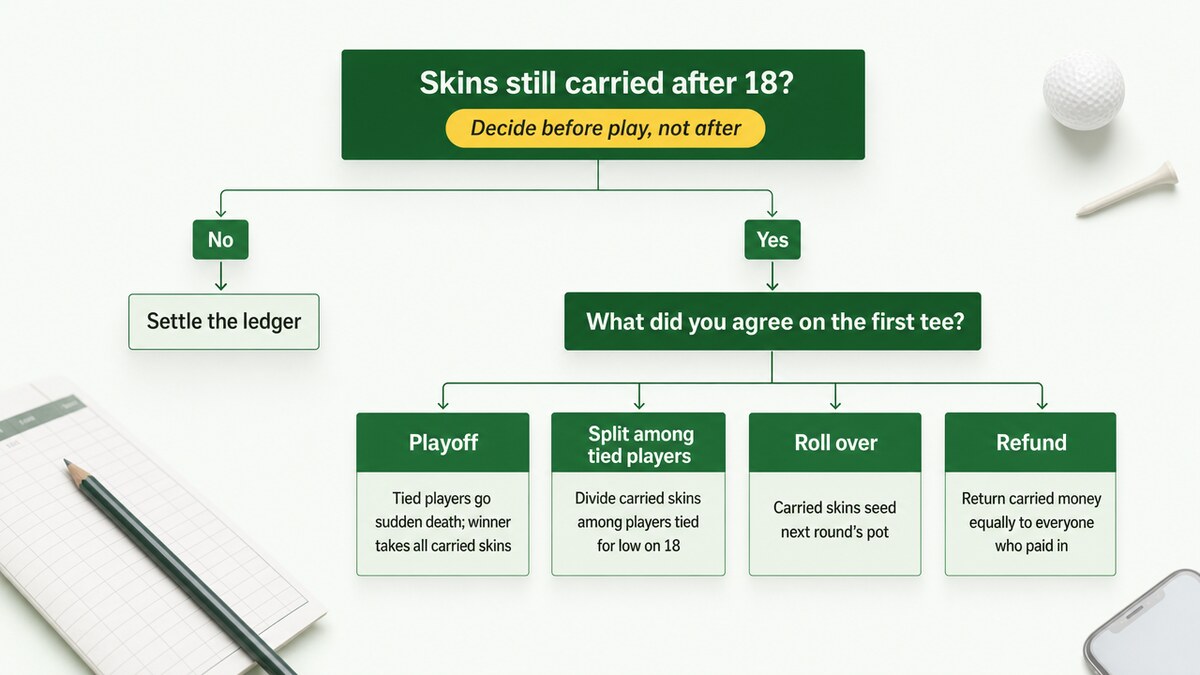
Using the $16 left over in the example:
- Sudden-death playoff. The players tied on 18 (A and C) play extra holes. The winner takes $16. If A wins, A finishes at +$36 and C stays at −$4. This makes the most sense when the course isn't busy.
- Split among the tied players. A and C get $8 each. Final: A +$28, B +$4, C +$4, D −$36.
- Roll over. The $16 goes into next week's game. This only works with a regular group.
- Refund. Each player gets $4 back. Final: A +$24, B +$8, C $0, D −$32.
With the split option, settling takes three payments: D pays A $28, B $4 and C $4. If the cash was collected up front, the holder just pays out each player's payout instead.
Net vs gross skins
Gross skins use actual strokes. The math is simple, and it works well when handicaps are close.
Net skins give handicap strokes (pops) on the hardest holes by stroke index. The stroke index ranks holes 1 to 18, with 1 the hardest. A Course Handicap of 14 gets one stroke on each of the 14 hardest holes. A 21 gets a stroke on every hole plus a second stroke on the three hardest.
The World Handicap System doesn't have a specific allowance for net skins, so your group sets its own terms. Its recommended allowances for similar formats, such as 100% for individual match play or 95% for individual stroke play, make a reasonable starting point. Common choices: Common choices:
- Play off the low player. The lowest handicap gets zero strokes, and everyone else gets the difference. Small groups use this a lot.
- Reduce the allowance. Full handicaps tend to favor higher handicappers in formats like this, because their scores swing more and they post more very low nets. Many groups reduce strokes for that reason. The USGA's recommended allowances for individual formats are 95% to 100% of Course Handicap, though some casual groups cut deeper.
- Cap strokes per hole. Allow at most one pop on any hole, so no one is getting two strokes on a skin.
- Gross beats net. When a gross score ties a net score for low, the gross score wins the skin.
To keep the pace up, many groups pick up at net double bogey: par plus two plus any strokes received on the hole.
Group size
- 2 players: This is basically match play with carryovers. It works, but there isn't much drama.
- 3 players: You get more outright wins and fewer carries.
- 4 to 5 players: This is the range most groups like. There are enough ties to build carryovers without long dry spells.
- Big fields (around 20 or more): Use pot skins with no carryovers. Some weekly games add a separate Super Skin on one hole that carries from week to week until someone wins it.
You can also play skins on stats instead of score, such as fairways, greens in regulation or putts. Or run individual skins alongside team better-ball skins in the same round.
This page is general information about running a friendly game. If you're organizing paid entries for a club or outing, check with a qualified professional.
Skins and Green Math
Skins is on the Green Math roadmap as coming soon, built for 2 to 8 players. Until it arrives, keep score with a pen and the ledger above.
Your group can play Wolf, Nines (5-3-1), Las Vegas and Bundle on Green Math today. Bundle is a one-pot game that's quick to settle. One person creates the round, everyone joins by QR code on their own phone, and the settlement matrix shows who pays whom in the fewest transactions.
Create a free account and play any of them free this weekend. Skins is next in line.
Frequently asked questions
Does a tie win the skin?
No. Two or more players tied for low score means nobody wins. Depending on your rules, the skin either carries to the next hole or goes dead.
How do you calculate a skins payout?
For per-hole skins, multiply the skins you won by the value of each skin, then subtract what you paid in. For pot skins, divide the total pot by the number of skins won across the field.
Do carryovers apply in field skins?
Usually not. With a big field, holes are commonly dead if tied, and the pot is shared among the outright winners. Agree on it at sign-up.
What if nobody wins a skin all day?
Refund everyone or roll the pot to the next round. Settle on which before play.
Does Green Math score Skins yet?
Not yet. Skins is listed as coming soon on the roadmap. Wolf, Nines, Las Vegas and Bundle are available now.