
How to Play the Animal Game in Golf (Zoo, Pig, Fish and The Bear)
In the Animal Game, also called Zoo or Zookeeper, you collect an "animal" each time you hit a certain bad shot. A ball in the water earns a frog, a bunker earns a camel, a three-putt earns a snake. At the end of the round, every animal costs its holder an agreed amount, and the player with the fewest animals collects.
No governing body publishes official Zoo rules. Every list you've seen is a house rule, so agree on yours before the first tee shot. Below is a default list you can use as written, plus the related games Pig, Fish and The Bear, and a full settlement walkthrough so nobody is doing long division in the parking lot.
On this page
Setup and player counts
The Animal Game works with 2 to 4 players, and most groups play it as a foursome. Everyone plays their own ball. You can run it on its own or as an add-on to a main game like Wolf or Nines.
Before you tee off, settle four things:
- The animal list and what triggers each one.
- Holding or passing (explained below).
- Point values for each animal and a dollar rate per point.
- Edge-case rules: double triggers, the vet, and tie-breaks.
Write these on the scorecard. It takes two minutes and removes most of the arguments.
The default animal list
Use this table as your starting point. Change any animal, trigger or value you like, as long as everyone agrees first.
| Animal | Trigger | Default value |
|---|---|---|
| Frog | Ball comes to rest in water or a penalty area | 2 points |
| Gorilla | Ball goes out of bounds | 2 points |
| Camel | Ball lands in a bunker | 1 point |
| Snake | Three-putt or worse | 1 point |
| Skunk | Double bogey or worse on a hole | 1 point |
| Woodpecker | Ball hits a tree | 1 point |
Water and out of bounds carry the higher value because they already cost you a penalty stroke, so the animal stacks on top of real damage. Under the Rules of Golf, any body of water on the course, such as a lake, pond, stream or ditch, counts as a penalty area whether or not it's marked. Puddles and other temporary water don't count.. That gives you a clean test for the frog: if it's water, it's a frog.
Some groups add animals for things like whiffs or tee shots that don't reach the forward tee. Keep the list to six or seven. More than that and the round turns into an audit.
Holding versus passing
This is the biggest rule choice, and groups often don't realize they're playing different versions until the settlement.
Holding (the Zoo)
Every animal you earn stays with you for the round. Find two bunkers and three-putt once, and you're carrying two camels and a snake. At the end you pay for everything in your zoo. This version rewards steady golf and keeps every hole relevant.
Passing (one of each animal)
Only one of each animal exists. It moves to the most recent player to trigger it. If you three-putt the 4th, you take the snake. If someone else three-putts the 9th, it moves to them. Whoever holds each animal after the 18th hole pays for it.
Passing keeps late holes tense, because one bad putt on 17 can cost you everything. It also means one rough stretch early in the round can be forgiven later.
Sending an animal to the vet
"Sending to the vet" means a good shot clears one animal you're holding. Common versions:
- A birdie sends any one animal to the vet.
- A sandy (up and down from a bunker for par) clears a camel.
- A par after finding water clears a frog.
In a holding game, the vet keeps a bad front nine from ending your interest in the bet. In a passing game, the cleared animal usually goes back to the middle until the next person triggers it. Pick one version and stick with it.
When one shot triggers two animals
If a shot hits a tree, kicks into a bunker and you then make double bogey, does that count as a woodpecker, a camel and a skunk? The simplest rule is to count every trigger. It's fair and easy to check. Groups that find this too harsh cap it at two animals per hole.
Point values and customizing them
A point system is easier than assigning dollar amounts to each animal. Set the values in the table, then pick a single rate per point, such as $0.25, $0.50 or $1. Changing the stakes then means changing one number.
Ways to adjust:
- Raise values on the shots that hurt your group most. If your course has water on half the holes, a 2-point frog can dominate. Drop it to 1.
- Double values on the back nine for a late swing.
- Give higher handicappers a break. Animal games are penalty-based, so a 20-handicap will collect more animals than a 5-handicap. Two easy fixes: give the higher player a set number of "immunity" holes (often matching their handicap strokes, using the dots on the card), or let them count skunks as triple bogey instead of double.
Keep stakes low enough that nobody minds losing. The game is about banter. This page is general information, not financial or legal advice. If you have questions about money and wagering where you play, check with a qualified professional.
Pig and Three Little Pigs
"Pig" is used two ways, which causes confusion.
Pig as an animal. Some groups add a pig to the zoo for a specific bad shot, such as a four-putt or a missed tap-in. Treat it like any other animal on your list.
Three Little Pigs (also called Strike Three). This is a separate scoring game. Each player plays stroke play, then throws out their three worst hole scores. The lowest adjusted total wins. Example: a player shoots 88 with an 8, 8 and 7 among their holes. They drop those three holes, and their adjusted score for the remaining 15 holes is 65.
Three Little Pigs pairs well with a zoo. The zoo punishes disasters, and the pigs forgive three of them. Decide whether you use gross or net scores before you start.
Fish
There are two common versions of Fish.
Fish as an animal or junk. A fishie is usually a par made on a hole where you found the water. In a zoo, some groups use a fish to cancel a frog, which works as a built-in vet.
Fish as its own birdie game. Each birdie earns a fish. The player with the most fish at the end wins the pot, or each fish is paid by every other player.
Tie-breaks for Fish:
- Split the pot evenly between tied players.
- Or the tied player with the lowest total score wins.
- Or the most recent birdie wins.
The Bear
The Bear (or Chasing the Bear) is a capture-and-hold game, similar to Rabbit. The first player with an outright low score on a hole captures the bear. Ties don't capture it.
In the standard version, the bear must be set free before anyone else can catch it. Another player's outright low score frees it, and the next outright low score captures it again. In the faster version, any outright low score takes the bear directly from the current holder.
There are usually two bets: whoever holds the bear after the 9th wins the front, and whoever holds it after the 18th wins the back.
Tie-breaks for The Bear: a tied low score never moves the bear. If it's loose (free) after 9 or 18, use a playoff on the next hole, carry that bet to the back nine, or split it. Agree on one before you start.
Worked settlement: a foursome after 18 holes
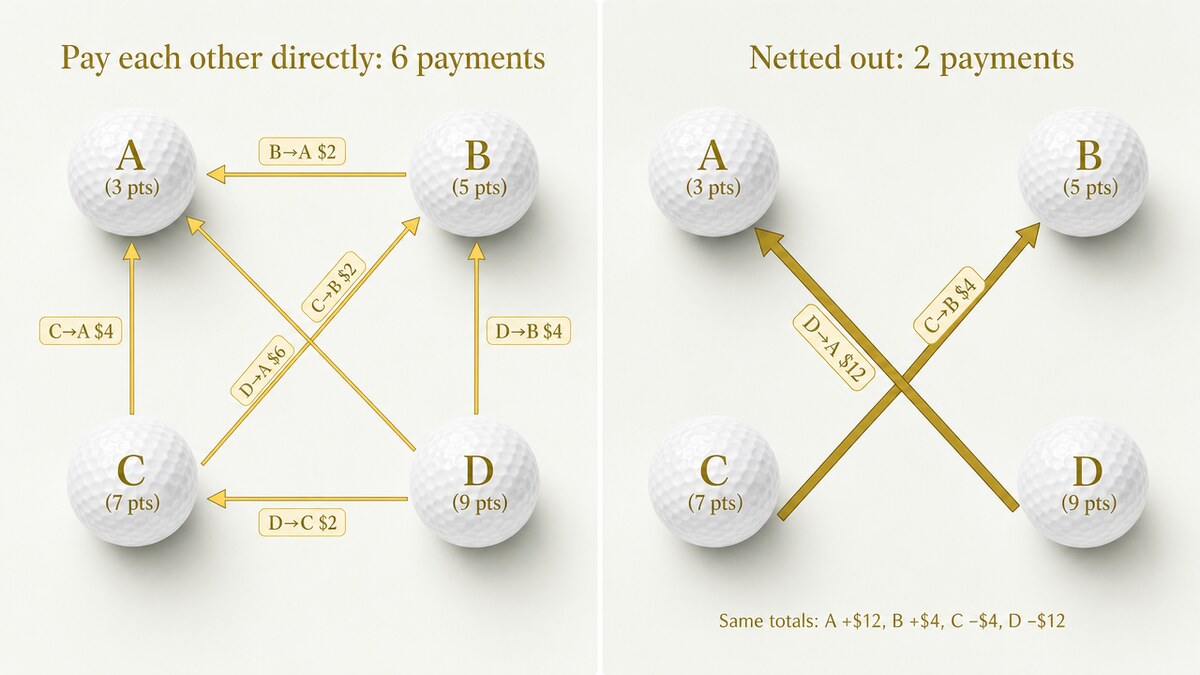
This example uses the holding model, the default values above, and $1 per point. Each player pays every other player the value of their own animals.
Step 1: Count each zoo.
- Player A: camel, snake, skunk = 3 points
- Player B: frog (2), camel, snake, skunk = 5 points
- Player C: gorilla (2), frog (2), camel, snake, woodpecker = 7, plus a second woodpecker sent to the vet with a birdie on 14 = 7 points
- Player D: frog (2), frog (2), gorilla (2), skunk, snake, camel = 9 points
Step 2: Total and net. The total is 24 points. Each player's net equals the points everyone else pays them minus what they pay out. A quick shortcut: net = total minus (4 × your points).
- A: 24 − 12 = +12
- B: 24 − 20 = +4
- C: 24 − 28 = −4
- D: 24 − 36 = −12
The nets add up to zero, so the math checks out.
Step 3: Minimize payments. Paying each other pairwise would mean six transfers. Netted out, it's two:
- D pays A $12
- C pays B $4
In a passing game, settlement is simpler. Each animal's holder after the 18th pays its value to each other player, or into a pot split by everyone who holds nothing.
Etiquette and pace of play
Penalty games depend on honest self-reporting. Players call their own animals, the same way they call their own penalties under the Rules.
- Call your animal before you leave the green, not three holes later.
- One person keeps the tally on the card, with a column per player and a mark per animal.
- Don't discuss triggers mid-swing. Banter is for the walk to the next tee.
- Settle up right after the round, while everyone still remembers the frog on 7.
Animals versus Bundle
If you like the idea of penalties but want a single pot, look at Bundle. It's the pot-based cousin of the Animal Game. Everyone antes in, one "bundle" passes to whoever goes out of bounds, finds water, three-putts or makes double, and a birdie steals it. The holder after 9 and 18 takes the pot.
The trade-off:
- Animal Game: many tokens, each bad shot has its own price, more detailed settlement. Good for groups that like a long list of jabs.
- Bundle: one token, one pot, no settlement math. Good for twilight nines and groups that want the drama without the bookkeeping.
If you'd rather reward good scores than punish bad ones, Nines gives a threesome nine points to split on every hole.
Score your next round without the math
Green Math doesn't score the Animal Game today. It does track Bundle automatically, passing the bundle on penalty events and handling the pot splits, along with Wolf, Nines and Las Vegas. Snake and Dots (junk) are on the roadmap. One person sets up the round, everyone else joins by QR code from their phone browser, and the settlement matrix shows who pays whom in as few payments as possible.
Create a free account and let your phone keep score while you keep the banter going.
Frequently asked questions
Is there an official list of animals for the Zoo game?
No. Every animal list is a house rule. Use the default table above or your own, and agree on it before the first tee.
What's the difference between Zoo and the Animal Game?
They're usually the same game under different names, along with Zookeeper. The bigger difference is whether your group plays holding (you keep every animal) or passing (one of each animal moves to the latest offender).
What does "sending to the vet" mean?
It's a good shot that clears an animal you're holding. Most often a birdie clears any animal, and a sandy clears a camel.
Who wins if two players three-putt the same hole in a passing game?
The usual rule is that the last player to hole out takes the snake. Agree on it beforehand so nobody argues about putting order.
How many players do you need?
Two to four, with foursomes most common. Three Little Pigs, Fish and The Bear all work with any group size from two up.
Can Green Math track the Animal Game?
Not today. Green Math scores Wolf, Nines, Las Vegas and Bundle. Bundle is the closest penalty-based game it handles automatically.