
How to Calculate Golf Side Bet Payouts: Wolf, Nines and Vegas
To calculate a golf side bet payout, total each player's points, convert points to dollars with an agreed stake, then net everyone into one balance and settle with as few payments as possible. For Wolf and Nines, the usual formula is (your points − the group's average points) × stake per point. For Las Vegas, it's the final point difference between the two teams × stake per point, and each player on the losing team pays that amount.
Below are the formulas, a worked example for each game, and the step most scorecards skip: turning a pile of IOUs into two or three clean payments. You can do all of this by hand. Green Math does it as you play.
This page covers scoring math only. It isn't legal or financial advice. If you have questions about betting where you play, ask a qualified professional.
On this page
Per-point vs per-hole: the two payout formulas
Before the first tee, your group picks one of two ways to turn points into money.
Per point. Every point has a fixed dollar value, for example $1. After the round you compare totals.
Payout = (player's points − average points) × stake per point
The average is the group's total points divided by the number of players. Anyone above it wins money and anyone below it pays. The balances always add up to zero.
Per hole. Each hole is worth a set amount, and the points on that hole split it. In Nines this is easy because every hole hands out exactly 9 points. A $9 hole works out to $1 per point, so per-hole Nines settles the same way as $1-per-point Nines. In Wolf, per-hole play tends to swing harder, so spell out exactly how a hole's points convert before anyone tees off.
Average method vs pay-the-difference
Some groups settle points games pairwise, with every player paying every other player the gap between their totals. That's legitimate, but it isn't the same bet. Pairwise settling multiplies each person's result by the number of players. In a threesome, a player who's 8 points above average wins $8 under the average method and $24 pairwise.
Neither method is wrong. Problems start when half the group assumed one and half assumed the other. Decide out loud and write it down.
Wolf payout example
Wolf is a four-player game where the Wolf role rotates each hole. The Wolf can pick a partner, go Solo after seeing tee shots, or declare Lone Wolf before anyone hits. Green Math's default points:
- Wolf and partner win: 2 points each
- Wolf's team loses: each defender gets 1 point
- Solo Wolf wins: 3 points
- Lone Wolf wins: 4 points
House rules vary a lot here. Some versions give the winning defenders more than 1 point each, and some add a Blind Wolf multiplier. Agree on the numbers first, because they change every total.
Worked example, $1 per point, 18 holes:
| Player | Points | vs average (20) | Payout |
|---|---|---|---|
| A | 26 | +6 | wins $6 |
| B | 21 | +1 | wins $1 |
| C | 19 | −1 | pays $1 |
| D | 14 | −6 | pays $6 |
Total points: 80. Average: 80 ÷ 4 = 20. The balances sum to zero, which is your check that the math is right.
Nines payout example
Nines (5-3-1) is a three-player game that hands out 9 points per hole: 5 for low, 3 for middle, 1 for high. Ties split the points for the tied positions (4-4-1 or 5-2-2), and a three-way tie is 3-3-3. With the optional Blitz rule, a player who beats the second-best score by 2 or more strokes takes all 9.
Because every hole is worth 9 points, an 18-hole round always totals 162 points. That gives you a built-in error check.
Worked example, $1 per point, 18 holes:
| Player | Points | vs average (54) | Payout |
|---|---|---|---|
| A | 62 | +8 | wins $8 |
| B | 54 | 0 | even |
| C | 46 | −8 | pays $8 |
62 + 54 + 46 = 162, so the scorecard adds up. The average is 162 ÷ 3 = 54. If your totals don't reach 162, a hole was scored wrong. Find it before anyone pays.
Las Vegas point-differential payout
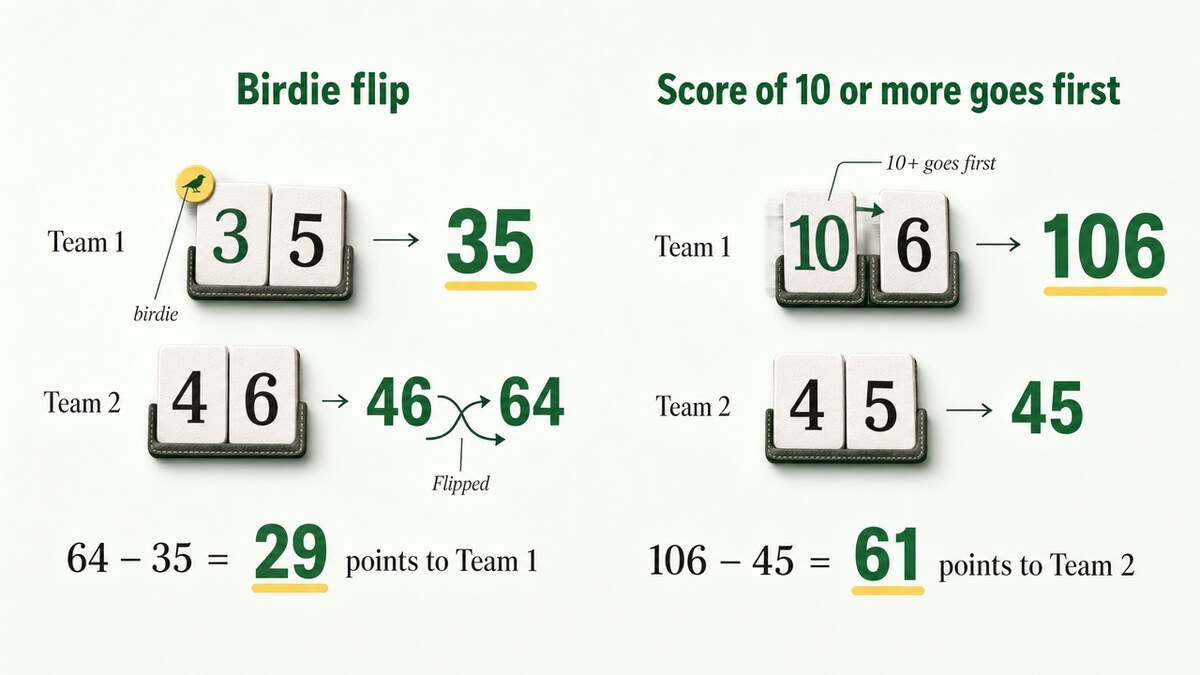
Las Vegas pits two teams of two against each other. On each hole, each team combines its two scores into one number with the lower score first, so a 4 and a 5 make 45. The lower team number wins the hole, and the difference is the points won.
Two rules drive the big swings:
- Scores of 10 or more go first. A 6 and a 10 make 106, not 610. A blow-up hole costs you badly.
- Flip the Bird. When a team makes birdie, the opponents' number is reversed. A 46 becomes 64.
Three-hole example:
| Hole | Team 1 | Team 2 | Result |
|---|---|---|---|
| 1 | 4, 5 → 45 | 5, 5 → 55 | Team 1 +10 |
| 2 (par 4) | 3, 5 → 35 (birdie) | 4, 6 → 46, flipped to 64 | Team 1 +29 |
| 3 | 6, 10 → 106 | 4, 5 → 45 | Team 2 +61 |
After three holes, Team 1 has 39 points and Team 2 has 61. Team 2 leads by 22.
Payout per player = point difference × stake per point
At $0.25 per point, 22 × $0.25 = $5.50. Each Team 1 player pays $5.50, and each Team 2 player receives $5.50. Because swings can run to dozens of points on a single hole, Vegas stakes usually sit well below what you'd play Wolf or Nines for.
Netting balances across players
Many groups play more than one bet in a round. The mistake is settling each game separately. You end up with a string of payment requests, some of which cancel each other out.
The fix is simple. Add up each player's result across every game into one number, then settle that number once.
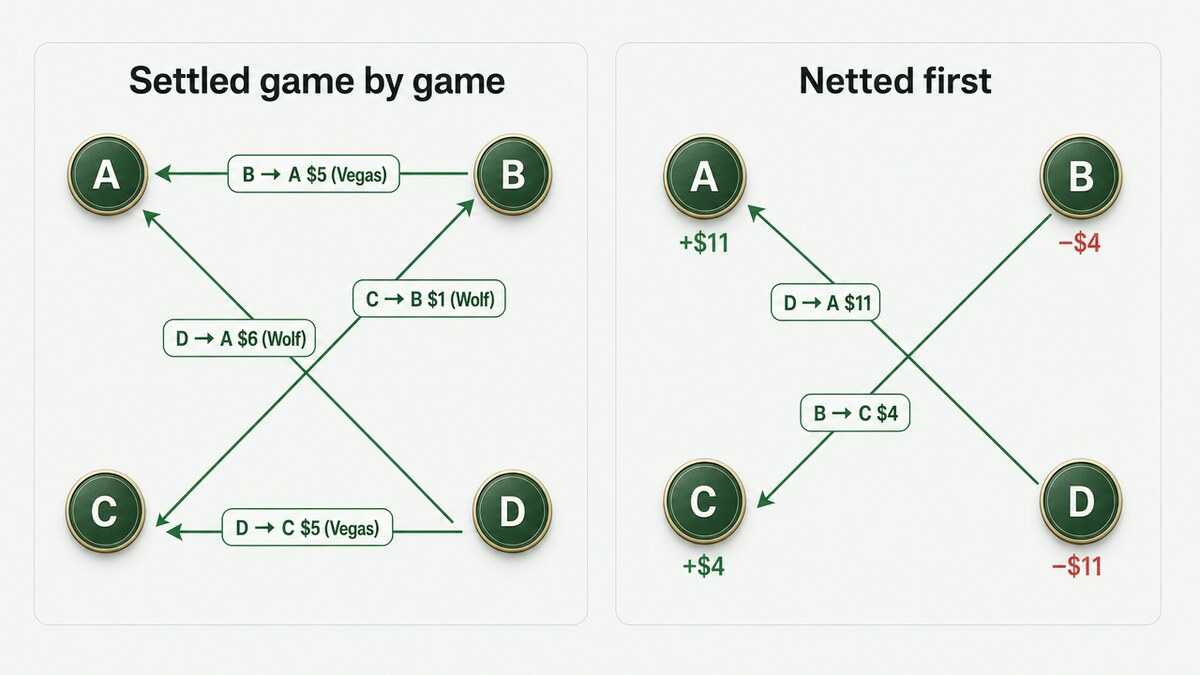
Example. The same foursome plays Wolf (results from the table above) and a Vegas match where A and C beat B and D for $5 each.
| Player | Wolf | Vegas | Net balance |
|---|---|---|---|
| A | +6 | +5 | +11 |
| B | +1 | −5 | −4 |
| C | −1 | +5 | +4 |
| D | −6 | −5 | −11 |
Settled game by game, that's four payments: D pays A $6, C pays B $1, B pays A $5, D pays C $5. Netted first, it's two: D pays A $11, B pays C $4. Everyone ends up in the same place with half the transfers.
How minimum-transaction settlement works
Once every player has a single net balance, you can reduce payments to the minimum with a few steps:
- List the players who are owed money (positive balances) and the players who owe (negative balances).
- Have the biggest debtor pay the biggest creditor as much as they can.
- That payment clears at least one of the two balances. Cross them off and repeat.
Since each payment clears at least one player, a group of n players never needs more than n − 1 payments. A foursome needs three at most, and often fewer, as in the example above.
This is what Green Math's settlement matrix does for your round. It shows exactly who pays whom, with the minimum number of transactions, so nobody has to work it out on the back of a scorecard.
Settle the house rules before you tee off
Most 19th-hole arguments are about rules, not arithmetic. Agree on these first and write them in the group chat:
- Stake and method: per point or per hole, and average or pairwise
- Wolf values: points for Lone Wolf, defender wins, and whether Blind Wolf counts
- Vegas: whether Flip the Bird is on, and whether tied holes carry over
- Nines: whether Blitz is on
- Odd cases: what happens if a player leaves mid-round, how picked-up holes get scored, and whether you cap blow-up holes
Green Math can allocate handicap strokes by stroke index once you pick a course and tees, or score the net scores you enter. Any per-hole cap is your group's call, so agree on it before you start.
Paying up
Green Math tells you who owes whom. The money moves through whatever payment app your group already uses. A few habits keep it painless:
- Confirm totals before anyone leaves the parking lot. Pull up the settlement screen together so everyone sees the same numbers.
- Pay on the spot. A payment sent at the car beats a reminder sent on Tuesday.
Try it free with Nines
Green Math is free: Wolf, Nines, Las Vegas, Bundle and every other feature, with no ads and no credit card. One person creates the round, shares a QR code, and everyone else joins from their phone's browser with no download. Following along needs no account; anyone entering their own scores signs up free.
Start your free round and let someone else's beer go warm for once.
Frequently asked questions
Is there a standalone payout calculator I can use without playing a round?
Green Math is built to score the round as you play it. You enter scores hole by hole, and the payouts calculate themselves. If you just want to check a finished round by hand, the formulas above cover Wolf, Nines and Vegas.
Does Green Math send the money?
No. Green Math calculates the balances and shows the minimum set of payments. You pay each other however your group usually does.
Do all the players need an account?
Not to follow along. Anyone can scan the QR code and watch the live leaderboard on their own phone with no account. Entering scores takes a free account, or one person can keep score for the whole group.
Do I need to connect a handicap or GHIN account?
No. There's no GHIN login and no GPS. Handicaps are optional: pick a course and tees and Green Math allocates strokes by stroke index, or skip the course and enter net scores.
Which games are free?
All of them. Wolf, Nines (5-3-1), Las Vegas, Bundle and every other feature are free, with full scoring and settlements.
Why don't my Nines totals add up?
Every hole in Nines hands out exactly 9 points, so 18 holes should total 162. If your totals come up short or long, a tie or a Blitz hole was scored wrong. Find that hole before anyone pays.