Las Vegas Golf Game Rules: Scoring, Flip the Bird and Variations
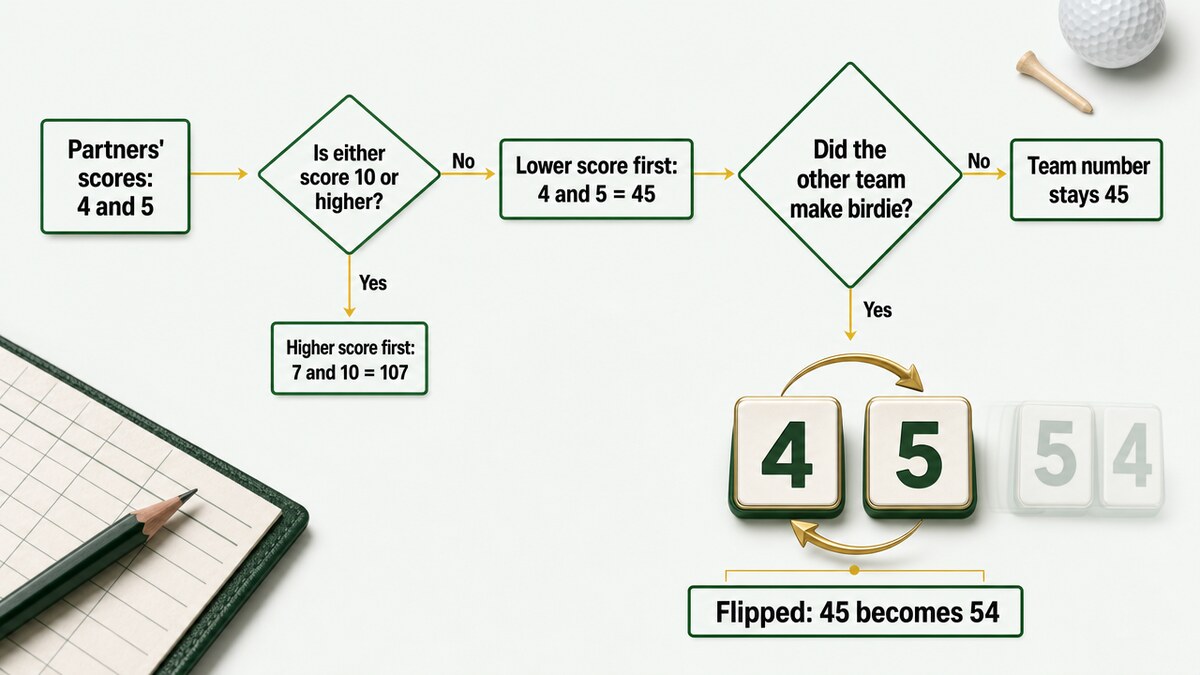
In Vegas, two teams of two turn each hole into a two-digit team number by putting the partners' scores side by side, lower score first. A 4 and a 5 make 45, not 9. The team with the lower number wins the hole and collects the difference in points. If a team makes birdie, the other team's number is flipped, so 45 becomes 54.
The rest is detail: double digits, flips, house rules and settling up. This page walks through every edge case with real numbers and finishes with a full 18-hole round.
Players: 4 · Length: 18 holes · Difficulty: Moderate · Best for: Teams
On this page
- How to play Vegas, step by step
- Double-digit scores
- Flip the Bird: birdie and eagle rules
- Gross or net Vegas, and how handicaps move the digits
- Variations: Daytona, Monte Carlo and LCR
- Rotating vs fixed teams
- Stakes: how fast the money moves
- A full 18-hole round, settled
- Pre-round checklist
- Strategy
- Score Vegas automatically with Green Math
- Frequently asked questions
How to play Vegas, step by step
1. Form teams
Split into two teams of two before teeing off. Partnerships stay the same for the whole round, or you can switch at the turn if your group prefers.
2. Play each hole
All four players play stroke play and record their own score. Both partners' scores count on every hole. A team can't hide a bad score behind a good one the way it can in best ball.
3. Build the team numbers
Put each team's two scores together as a two-digit number, lower score first.
- Team 1: Player A scores 5, Player B scores 4 → 45
- Team 2: Player C scores 4, Player D scores 6 → 46
4. Score the hole
The lower number wins. The points equal the difference between the two numbers. In the example, Team 1 wins 1 point (46 − 45).
The difference is always the gap between the numbers, whichever team is higher:
| Team numbers | Points |
|---|---|
| 34 vs 45 | 11 |
| 56 vs 47 | 9 |
| 35 vs 107 | 72 |
Ties push. If both teams post the same number, nobody gets points on the hole.
Double-digit scores
A 10 or worse on a single hole breaks the normal order. In standard Vegas the higher score goes first, which punishes blow-up holes hard:
- Scores of 7 and 10 = 107 (not 710)
- Scores of 11 and 6 = 116
This is the only case where the bigger number leads. One partner's disaster can cost a team 50 points or more on a single hole.
Groups that find this too brutal have a few options. Agree on whichever one you want before the round:
- Play it straight. Higher score first, as above. This is the classic rule.
- Cap the hole score. Borrow the idea behind the Maximum Score format and set a limit per player. It can be a fixed number such as 8, triple bogey, or net double bogey. Nobody can post a 10, so nobody can post 107.
- Let a player pick up. This only works if you agree in advance on the score they take. Both partners' numbers count in Vegas, so an incomplete hole needs a number.
Flip the Bird: birdie and eagle rules
When one team makes a birdie, the opponents' team number flips: the digits reverse. A flip turns a close hole into a big one.
Birdie flip example (par 4):
- Team 1 scores 3 and 5 = 35 (Team 1 made birdie)
- Team 2 scores 4 and 5 = 45, which flips to 54
- Team 1 wins 19 points (54 − 35)
Without the flip, that hole is worth 10. Birdies are worth far more in Vegas than in a normal match, so it pays to be aggressive with birdie putts.
House rules to settle on flips
These vary from group to group. Decide them on the first tee, not on the 7th green.
- Both teams birdie. Most groups let the flips cancel, so neither number flips.
- Eagles. Common options are that an eagle flips and doubles the hole's points, or that it counts the same as a birdie.
- Gross or net birdies. In a net game, decide whether a net birdie triggers a flip or only a real one.
- Flipping big numbers. Decide what happens when the team you're flipping has a three-digit number like 107. Some groups skip the flip in that case.
- No-flip Vegas. Some groups drop the flip entirely for a calmer game.
Gross or net Vegas, and how handicaps move the digits
You can play Vegas with gross scores or with handicap strokes applied. Agree on which before you tee off.
In a net game, a single stroke can change more than one digit. It can reorder the number entirely. Say it's a par 4. Player A has no stroke and scores 4. Player B gets two strokes on the hole and makes a gross 5.
- Gross: 4 and 5 = 45
- Net: 4 and 3 = 34
That one stroke allocation is worth 11 points before the other team has putted out.
For four-ball formats, the USGA recommends a handicap allowance. In four-ball match play, the lowest-handicap player plays off scratch, and each other player gets 90% of the difference between their Course Handicap and the low player's. In four-ball stroke play, there's no stroking off the low player: each player simply gets 85% of their own Course Handicap. Under that approach, Course Handicaps of 10, 18, 27 and 39 become Playing Handicaps of 0, 7, 15 and 26. Vegas pits team against team on every hole, so many groups borrow the match-play figure. Plenty of others simply use full handicaps. There's no single right answer.
Variations: Daytona, Monte Carlo and LCR
Vegas has a lot of relatives, and the names get used loosely. Here is how the common ones generally work. Confirm your group's version before money is involved.
Daytona (par-or-worse ordering)
Daytona adds a par rule to digit order. If at least one partner makes par or better, the lower score goes first as usual. If both partners are over par, the higher score goes first. A bad hole gets punished even without a double digit.
Monte Carlo
Instead of putting the scores side by side, you multiply them. A 4 and a 5 make 20. The lower product wins the difference. Swings are much smaller than in Vegas.
Vegas LCR
In LCR, teams aren't fixed. Partnerships are set hole by hole based on where tee shots finish, so you might partner with a different player every hole. Some versions also raise the point value as the back nine goes on. LCR rules vary more than any other version, so write yours down.
The same hole under each format
Par 4. Team 1 scores 4 and 5. Team 2 scores 5 and 6.
| Format | Team 1 | Team 2 | Points to Team 1 |
|---|---|---|---|
| Vegas | 45 | 56 | 11 |
| Daytona | 45 | 65 (both over par) | 20 |
| Monte Carlo | 20 | 30 | 10 |
Same golf, very different money. That's why the format matters as much as the stake.
Rotating vs fixed teams
Fixed teams are the standard. You keep your partner for 18 holes, which rewards good pairings and makes settlement simple.
Switching at the turn keeps things fresh if one team is running away with it. You can settle each nine separately, or track each player's total across both partnerships.
Rotating every six holes borrows from Sixes, also called Hollywood or Round Robin. Everyone plays with and against everyone in the foursome. It's the fairest option when skill levels are uneven.
If your group likes changing partners every hole and making decisions on the tee, that's closer to Wolf than to Vegas.
Stakes: how fast the money moves
Set a value per point. Because swings are large, per-point stakes in Vegas run much lower than in most games:
- Conservative: $0.10 – $0.25 per point
- Moderate: $0.50 – $1.00 per point
- Aggressive: $1+ per point
A nickel a point is common for casual groups. A single hole can easily swing 10 points, and a flip or a double digit can swing 50.
Compare that with a $2 Nassau, where the most a player can lose is $6. Vegas has no built-in ceiling. If you want one, set a cap on hole scores, points per hole, or total loss before the round. This page is general information about a friendly game, not legal or financial advice. If you have questions about playing for money where you live, ask a qualified professional.
If your group wants side-game action with smaller, steadier swings, a threesome can play Nines instead.
A full 18-hole round, settled
Here's a complete gross round with standard rules. Birdies flip, both-team birdies cancel, and double digits go first. Team 1 is A and B. Team 2 is C and D. "Running" shows Team 1's position. A negative number means Team 2 is ahead.
| Hole | Par | Team 1 | Team 2 | Result | Running |
|---|---|---|---|---|---|
| 1 | 4 | 4, 5 = 45 | 5, 5 = 55 | T1 +10 | +10 |
| 2 | 4 | 5, 6 = 56 | 4, 5 = 45 | T2 +11 | −1 |
| 3 | 3 | 3, 4 = 34 → 43 | 2, 4 = 24 (birdie) | T2 +19 | −20 |
| 4 | 5 | 5, 5 = 55 | 5, 6 = 56 | T1 +1 | −19 |
| 5 | 4 | 3, 5 = 35 (birdie) | 4, 5 = 45 → 54 | T1 +19 | 0 |
| 6 | 4 | 4, 4 = 44 | 4, 4 = 44 | Push | 0 |
| 7 | 3 | 3, 3 = 33 | 3, 4 = 34 | T1 +1 | +1 |
| 8 | 4 | 5, 10 = 105 | 5, 6 = 56 | T2 +49 | −48 |
| 9 | 5 | 5, 6 = 56 | 6, 6 = 66 | T1 +10 | −38 |
| 10 | 4 | 4, 5 = 45 | 4, 4 = 44 | T2 +1 | −39 |
| 11 | 4 | 3, 4 = 34 (birdie) | 3, 5 = 35 (birdie) | Flips cancel, T1 +1 | −38 |
| 12 | 3 | 3, 4 = 34 | 4, 5 = 45 | T1 +11 | −27 |
| 13 | 5 | 4, 5 = 45 (birdie) | 5, 7 = 57 → 75 | T1 +30 | +3 |
| 14 | 4 | 4, 4 = 44 | 5, 5 = 55 | T1 +11 | +14 |
| 15 | 4 | 5, 6 = 56 | 4, 5 = 45 | T2 +11 | +3 |
| 16 | 3 | 3, 3 = 33 | 3, 3 = 33 | Push | +3 |
| 17 | 4 | 4, 5 = 45 → 54 | 3, 4 = 34 (birdie) | T2 +20 | −17 |
| 18 | 5 | 5, 6 = 56 | 4, 8 = 48 | T2 +8 | −25 |
Points won: Team 1 94, Team 2 119. Team 2 wins by 25 points.
Each player on the losing team owes the differential times the point value:
| Point value | Each Team 1 player pays | Each Team 2 player receives |
|---|---|---|
| $0.05 | $1.25 | $1.25 |
| $0.25 | $6.25 | $6.25 |
| $1.00 | $25.00 | $25.00 |
It settles in two payments: A pays C, and B pays D.
The round looks close at the end, but it wasn't steady. Hole 8 alone was worth 49 points, almost twice the final margin. Team 1 erased a 38-point deficit with two birdie flips and then gave most of it back on 17. At $1 a point, the swing on hole 8 was $49 per player.
Here's another way to read a result. If Team 1 finishes with 85 points and Team 2 with 120, the 35-point gap at $0.25 means each Team 2 member receives $8.75 and each Team 1 member pays $8.75.
Pre-round checklist
Settle these before the first tee shot:
- Gross or net, and which handicap allowance
- Double digits: higher score first, a score cap, or a set pick-up score
- Birdie flips on or off, and whether gross or net birdies count
- What happens when both teams birdie
- Eagle rule: same as a birdie, or double points
- Whether three-digit numbers flip
- Point value, plus any per-hole or per-round cap
- Fixed teams, a switch at the turn, or rotation
- Ties push, or carry points forward to the next hole
- Presses: extra side bets when a team falls behind by a set margin
- Nassau-style: front 9, back 9 and overall as three separate matches
Strategy
- Avoid the second digit disaster. Your team number is only as good as your worse score. If your partner is in trouble, play the boring shot and post a par or bogey.
- Play safe when your partner is struggling. A double bogey from one player turns a 45 into a 46 at best and a 47 at worst. A 10 turns it into 105.
- Go for birdies. Thanks to the flip, birdie putts are where the big points are. You only need one birdie look per team.
- Talk to your partner. Each side may play in whatever order suits it, so the partner in a safe position can go first and free the other to attack. Knowing your partner's lie tells you when to play safe and when to be aggressive.
- Use a cap if swings scare the group. A hole limit trims the worst outcomes without changing the feel of the game.
Score Vegas automatically with Green Math
Green Math builds the team numbers, applies the pairing rules, handles birdie flips (it asks on each hole), calculates the point difference on every hole and settles payments. Nobody has to keep a running total in their head on the 14th tee.
Las Vegas with Flip the Bird is free in Green Math, like Wolf, Nines, Bundle and every other feature, with no ads and no credit card.
One person creates the round, picks Las Vegas and sets the point value, then shares a QR code. Everyone else joins in their phone's browser with no download. Following along needs no account; anyone entering their own scores signs up free, or one person keeps score for the group. The live leaderboard updates hole by hole. At the end, the settlement matrix shows who pays whom in the fewest transactions. Pick a course and tees and Green Math allocates handicap strokes by stroke index, or skip the course and enter net scores.
Start your round free at Green Math or see how Green Math works.
Frequently asked questions
Is Vegas played with gross or net scores?
Either works. Agree before the round. In a net game, a handicap stroke can reorder a team's digits, so it pays to know your stroke holes before you tee off.
What happens if both teams make birdie?
Most groups let the flips cancel, so both numbers stay as they are and the lower one wins. Some groups flip both. Pick one and stick with it.
How do eagles work in Vegas?
There's no single standard. The usual choices are treating an eagle like a birdie, or flipping the opponents' number and doubling the points. Decide in advance.
What's the difference between Vegas and Monte Carlo?
Vegas puts the two scores side by side (4 and 5 = 45). Monte Carlo multiplies them (4 × 5 = 20). Monte Carlo produces much smaller swings for the same golf.
Can Green Math score Daytona or LCR?
Not yet. Green Math scores standard Las Vegas with Flip the Bird. Daytona is on our roadmap.
Does everyone in the foursome need an account?
Not to follow along. Anyone can scan the QR code and watch the live leaderboard in their phone's browser with no account. Entering scores takes a free account, or one person can keep score for the whole foursome.