
How to Settle Golf Bets Fast: Who Owes Whom, in the Fewest Payments
To settle golf bets, combine everything each player won and lost across every game into one net balance. Check that the balances add up to zero. Then have the biggest loser pay the biggest winner, and repeat until everyone sits at zero. A foursome never needs more than three payments this way, no matter how many games or side bets you played.
That's the whole method. The rest of this page shows why it works, walks through a full four-player example, and covers the rounding, etiquette and dispute issues that usually stall the 19th hole.
On this page
- Why manual settlement goes wrong
- Step 1: Net each player's balance
- Step 2: Combine every game into one settlement
- Step 3: Settle in the fewest payments
- Rounding without breaking the math
- When the shortcut isn't the right call
- Paying up
- Etiquette that prevents arguments
- Use saved round history to end disputes
- How Green Math handles it live
- Frequently asked questions
Why manual settlement goes wrong
The math isn't hard. There's just a lot of it, and it happens when everyone is tired and thirsty.
- Too many lines. A Nassau, a points game and a handful of junk bets can easily produce ten or more separate debts in one foursome. Each press adds another.
- Pairwise thinking. Most groups settle bet by bet: "I owe you $4 for the Nassau, you owe me $3 for sandies." People send both payments instead of netting them, so money goes back and forth.
- Lost context. By the time you settle, nobody remembers whether hole 7 was a push or whether the Lone Wolf won.
- Broken spreadsheets. One wrong cell three holes ago and every total after it is off.
The fix is to stop thinking in pairs and start thinking in balances.
Step 1: Net each player's balance
A player's net balance is everything they're owed minus everything they owe. Who they owe it to doesn't matter for this step. If Al owes Bo $5 and Bo owes Cy $5, Bo is even. Al can pay Cy directly and Bo never touches the money.
One check catches nearly every mistake: all balances in the group must add up to exactly zero. Every dollar someone wins, someone else loses. If your total comes out at +$2, an error is hiding somewhere. Find it before anyone pays.
Points games convert to balances first
Per-point games like Wolf and Nines are usually settled against the average. Total everyone's points, find the average, and each player wins or pays the difference times the stake. In a $1-per-point Wolf game with final totals of 28, 24, 20 and 16, the average is 22, so the balances are +$6, +$2, −$2 and −$6. They already sum to zero.
Step 2: Combine every game into one settlement
Don't settle game by game. Work out each game's balances separately, then add them up per player. One combined number per person is all you need.
A worked 4-player example
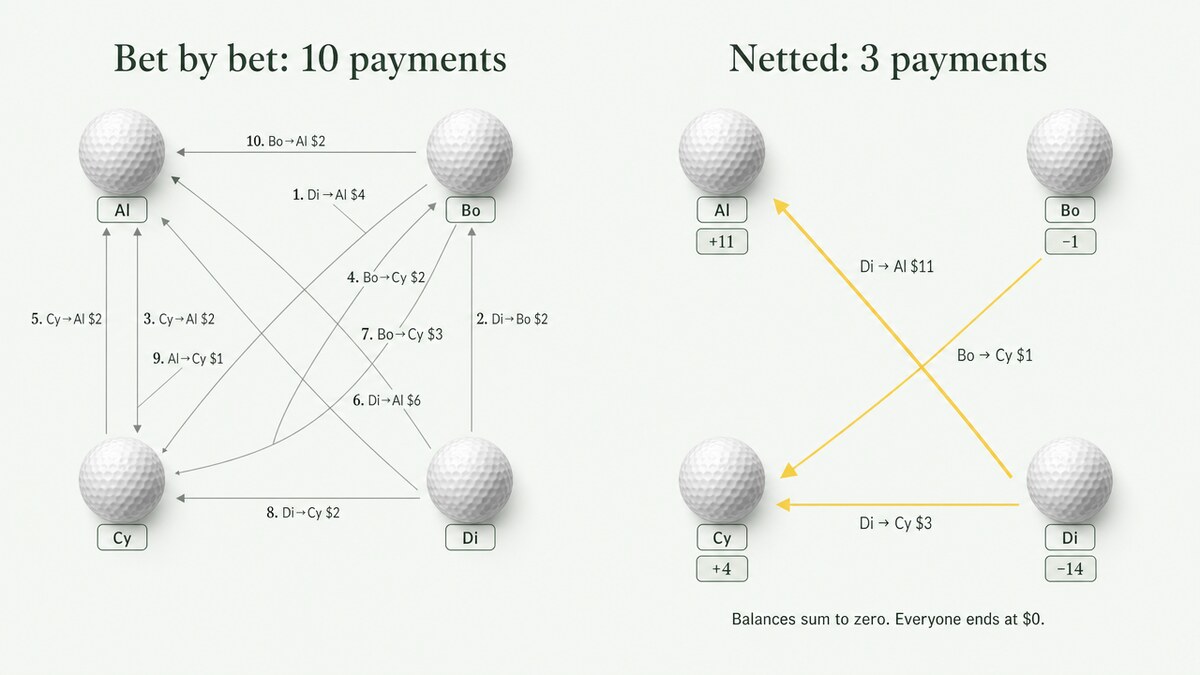
Al, Bo, Cy and Di play a $2 Nassau against each other, $1-per-point Wolf, and $1 junk bets.
Raw debts as they came in:
| Game | Debts |
|---|---|
| Nassau | Di owes Al $4, Di owes Bo $2, Cy owes Al $2, Bo owes Cy $2 |
| Wolf | Al +$6, Bo +$2, Cy −$2, Di −$6 |
| Junk | Bo owes Cy $3, Di owes Cy $2, Al owes Cy $1 |
Settled line by line, that's ten or more payments.
Net balances per game, then combined:
| Player | Nassau | Wolf | Junk | Net |
|---|---|---|---|---|
| Al | +6 | +6 | −1 | +11 |
| Bo | 0 | +2 | −3 | −1 |
| Cy | 0 | −2 | +6 | +4 |
| Di | −6 | −6 | −2 | −14 |
Check: 11 − 1 + 4 − 14 = 0. Good to go.
Step 3: Settle in the fewest payments
Match the biggest debtor with the biggest creditor. The debtor pays as much as possible until one of them reaches zero. Repeat.
- Di (−14) pays Al (+11) $11. Al is done. Di is at −3.
- Di (−3) pays Cy (+4) $3. Di is done. Cy is at +1.
- Bo (−1) pays Cy (+1) $1. Everyone is at zero.
Three payments instead of ten. Confirm each player's final balance is zero before anyone opens a payment app.
How many payments to expect
This greedy approach settles any group of n players in at most n − 1 payments, so three for a foursome. Sometimes you can do better. If two players' balances exactly cancel (one is +$5, another −$5), pair them off first and you may need only two payments. Finding the true minimum for big groups gets complicated, but for a golf group, look for exact matches first, then go greedy.
Rounding without breaking the math
Per-point games throw off odd cents. In a three-player Nines game at $1 a point, final totals of 94, 78 and 66 work out to +$14.67, −$1.33 and −$13.33.
If you round everyone to the nearest dollar, you get +15, −1 and −13. That sums to +1, so someone gets shorted. The cleaner rule is to round every balance except one, then set the last one to whatever brings the total back to zero. Round the two losers to −$1 and −$13, and the winner collects $14. Agree on the rounding rule on the first tee, not after the round.
When the shortcut isn't the right call
Fewest payments isn't always the friendliest option. In the example, Di pays Al $11 even though part of that came from Wolf, which was settled against the group average rather than head to head. Most groups don't care. Some players do.
- Someone wants to pay only the person they bet with. That's fair. Settle that pair directly, then net the rest.
- A player would end up paying a stranger. If a guest would be sending money to someone they never played against, offer pairwise settlement for them.
- Mixed groups and new players. Explain netting before the round. "You'll pay one person, and it's the right total" goes over better on the first tee than at the car.
Paying up
Green Math tells you who pays whom. The money itself moves through whatever your group already uses.
A few practical habits:
- Confirm the recipient before you send. The FTC warns that money sent through payment apps behaves like cash and is very hard to get back.
- Check your privacy settings. Some payment apps have historically shown payment names and notes on a social feed by default, and settings and defaults can change, so check yours and the per-payment audience before you send. Keep notes bland ("Saturday golf") if you'd rather not broadcast the round.
- Settle before the parking lot. QR payments need a camera and a signal, and some courses have weak coverage. Do it in the clubhouse while everyone is still together.
This page is general information about organizing friendly bets, not financial or legal advice. If you have questions about your situation, consult a qualified professional.
Etiquette that prevents arguments
Most settlement fights are really first-tee failures. Before anyone hits, agree on:
- Games and stakes per point, per hole or per bet
- Handicap strokes and which holes they fall on
- Press rules and caps
- Las Vegas point values and whether birdie flips apply
- Rounding and minimum payout
Use saved round history to end disputes
When someone swears they halved hole 12, work through this list:
- Compare the hole-by-hole scorecard to the bet results. Most errors are one wrong score entered once.
- Recheck handicap strokes by stroke index. A stroke applied on the wrong hole flips results quietly.
- Fix errors hole by hole, during the round. Under the Rules of Golf for match play, a mistakenly agreed match score generally becomes final once either player tees off on the next hole (or, after the last hole, once the match result is final), with limited exceptions if an opponent gave a wrong stroke count or failed to report a penalty.
- Keep the record. Green Math saves every round, winner and settlement in a searchable history, so next week's argument has evidence.
How Green Math handles it live
One person creates a free account, picks the game and point values, and shares a QR code. Everyone else joins in their phone's browser with no download. Following along needs no account; anyone scoring themselves signs up free. The live leaderboard updates as you play, and the settlement matrix shows who pays whom with the minimum number of transactions. No GPS and no GHIN login.
Green Math is free: Wolf, Nines, Las Vegas, Bundle and every other feature, with no ads and no credit card. See how it works on the Green Math home page.
Retire from the accountant job. Create your free account and let the settlement matrix run the numbers next round.
Frequently asked questions
Does Green Math send or hold the money?
No. It calculates who owes whom and shows the fewest payments needed. Players pay each other directly, with a payment app or cash.
Does everyone in the group need an account?
Not to follow along. One person creates a free account and shares a QR code, and anyone can watch the live leaderboard in their phone's browser without an account or download. Entering scores takes a free account, or one person keeps score for the group.
Do I need to connect a handicap or GHIN?
No. Handicaps are optional: pick a course and tees and Green Math allocates strokes by stroke index, or skip the course and enter net scores.
Why do the balances always add up to zero?
Every dollar one player wins is a dollar another player loses. If your totals don't net to zero, there's an error to find before anyone pays.
Can we settle fewer than three payments in a foursome?
Sometimes. If two players' balances cancel exactly, pairing them off first can cut it to two payments. Three is the most a foursome ever needs.
Which games are free?
All of them. Wolf, Nines, Las Vegas, Bundle and every other feature are free, with full scoring and settlements.