How to Play Wolf Golf: Rules, Scoring, Variants and Settling Up
Wolf is a four-player points game where one player is the Wolf on each hole. The Wolf tees off last, watches the other three drives, and either picks one of those players as a partner for a two-vs-two best ball or plays alone against the other three for bigger points. The Wolf role rotates every hole, and whoever has the most points after 18 wins.
This page covers the full rules. It includes a rotation table for 3, 4 and 5 players, the point values for each Wolf decision, carryovers, a worked four-hole example and a settlement done three ways. It also gives a checklist of house rules to settle before anyone tees off, because most Wolf arguments start there.
At a glance: 4 players (3 or 5 also work) · 18 holes · Moderate difficulty · Best for groups who like strategy
On this page
- Set the tee order and the Wolf rotation
- When the Wolf picks a partner
- Wolf scoring: the point table
- Ties and carryovers
- Worked example: four holes with a running total
- Wolf with 3 or 5 players
- House-rule add-ons: hammers, Wolfhammer and Wolfman
- Gross or net scoring
- Stakes and settling up
- Strategy: when going alone pays
- Common disputes, and a pre-round checklist
- Scorecard math vs. scoring in Green Math
- Frequently asked questions
Set the tee order and the Wolf rotation
On the first tee, set a fixed order: Players 1 through 4. That order decides who is the Wolf on every hole. It also overrides the usual honor system. In most versions the order shifts each hole so the Wolf always hits last, no matter who won the previous hole.
Here is who is the Wolf on each hole, by group size:
| 3 players | 4 players | 5 players | |
|---|---|---|---|
| Player 1 | 1, 4, 7, 10, 13, 16 | 1, 5, 9, 13, 17* | 1, 6, 11, 16* |
| Player 2 | 2, 5, 8, 11, 14, 17 | 2, 6, 10, 14, 18* | 2, 7, 12, 17* |
| Player 3 | 3, 6, 9, 12, 15, 18 | 3, 7, 11, 15 | 3, 8, 13, 18* |
| Player 4 | — | 4, 8, 12, 16 | 4, 9, 14 |
| Player 5 | — | — | 5, 10, 15 |
*These holes create uneven Wolf turns if you follow a straight rotation.
The holes 17–18 catch-up rule
In a foursome, everyone is the Wolf four times over the first 16 holes. A straight rotation then hands holes 17 and 18 to Players 1 and 2, so those two get a fifth turn. Many groups use a catch-up rule instead: the player with the fewest points after 16 holes is the Wolf on both 17 and 18. This gives the trailing player a last shot and removes the tee-order advantage.
With five players, you have the same problem on holes 16–18. You can apply the same idea there. After 15 holes, hand the last three Wolf turns to the lowest point totals.
When the Wolf picks a partner
Partner selection happens one tee shot at a time. You don't wait until everyone has hit.
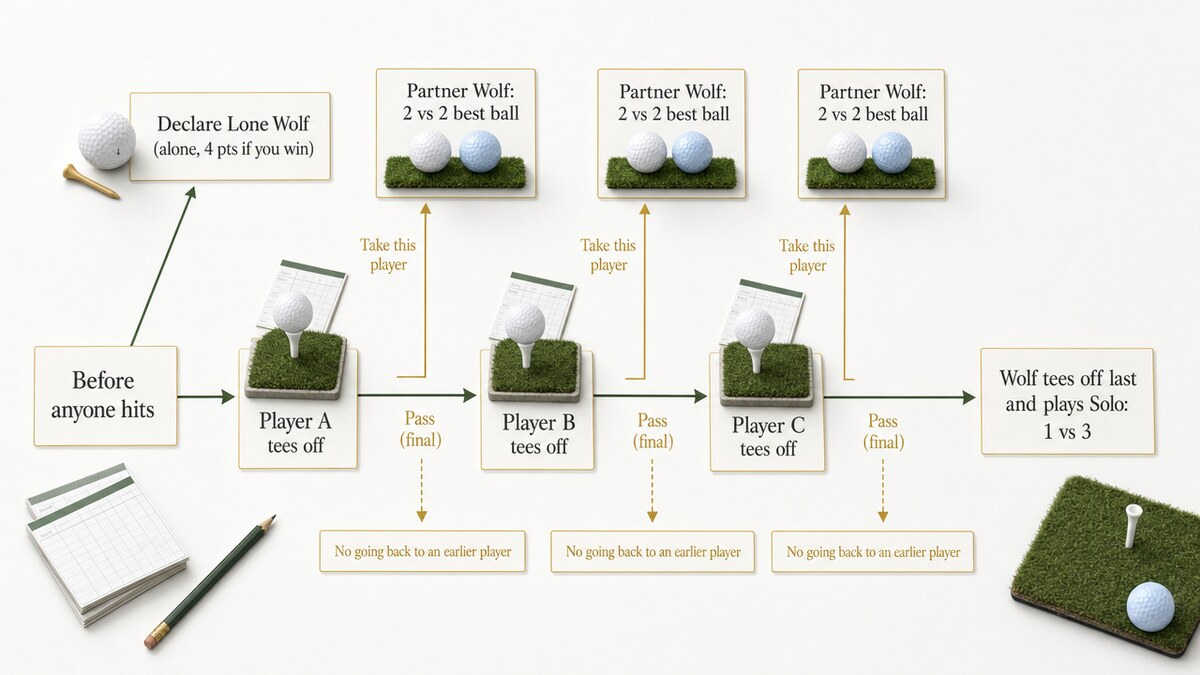
- The first player tees off. The Wolf decides right then: take this player, or pass.
- If the Wolf passes, the second player hits. The Wolf decides again.
- If the Wolf passes again, the third player hits. Last chance to pick a partner.
- If the Wolf passes on all three, the Wolf plays the hole alone against the other three.
A pass is final. You can't go back to Player 1 after seeing Player 2 hit into the trees. Make the call promptly so the group keeps moving.
Wolf scoring: the point table
Every hole is net best ball. Only the best score on each side counts, and the lower score wins the hole. Points depend on when the Wolf committed and whether the Wolf's side won.
These are the values Green Math uses:
| Wolf's decision | When it's made | Wolf side wins | Wolf side loses |
|---|---|---|---|
| Partner | After that player's tee shot | Wolf and partner get 2 each | Each defender gets 1 |
| Solo Wolf | After seeing all tee shots, passing on everyone | Wolf gets 3 | Each defender gets 1 |
| Lone Wolf | Before anyone hits | Wolf gets 4 | Each defender gets 1 |
Why names and numbers differ between groups
Wolf has no governing rulebook. Two common differences:
- What "Lone Wolf" means. Many groups use "Lone Wolf" for the Wolf who passes on everyone. They use "Blind Wolf" for the Wolf who announces going alone before anyone tees off, which is like going all in without looking at your cards. Under that naming, Lone Wolf often pays 4 and Blind Wolf pays more.
- What losers pay. Some groups give each defender 3 points when they beat a Wolf team. Others have a losing Lone Wolf pay 2 points to each player instead of 1. Even published rule sets disagree on this one.
Blind Wolf
Some groups let the Wolf declare "Blind Wolf" before anyone tees off, for triple the standard payout. It's the highest-risk call in the game. Agree on the multiplier and what it multiplies before the round starts.
Ties and carryovers
By default, a tied hole is a push and nobody scores.
Many groups borrow carryovers from Skins. With carryovers, a tied hole's value rides on the next hole, and the next outright winner collects both. Two ties in a row means the next hole pays triple. Some groups add a validation rule: the side that wins after a carryover must at least match the low score on the following hole to keep the carried points.
Carryovers make late holes swingy. Decide up front whether they're on and whether they cap.
Worked example: four holes with a running total
The players are Ann (Player 1), Ben (2), Cal (3) and Dee (4). The scores are net, and the example uses the point table above.
Hole 1, Ann is Wolf. Cal hits a good drive first, and Ann takes him. Ann/Cal's best ball is 4. Ben/Dee's best ball is 5. The Wolf team wins, so Ann and Cal get 2 points each.
Hole 2, Ben is Wolf. Ben passes on all three and plays Solo. His 4 ties the defenders' best ball of 4. Push.
Hole 3, Cal is Wolf. Cal declares Lone Wolf before anyone hits. He makes 5. The defenders' best ball is 4. Ann, Ben and Dee get 1 point each.
Hole 4, Dee is Wolf. Dee takes Ben. Their best ball is 4. Ann/Cal make 3. The defenders win, so Ann and Cal get 1 point each.
| After hole | Ann | Ben | Cal | Dee |
|---|---|---|---|---|
| 1 | 2 | 0 | 2 | 0 |
| 2 | 2 | 0 | 2 | 0 |
| 3 | 3 | 1 | 2 | 1 |
| 4 | 4 | 1 | 3 | 1 |
With carryovers on, hole 2's tie rides to hole 3, so the defenders get 2 each there. The totals after four holes become Ann 5, Ben 2, Cal 3, Dee 2. One house rule moved Ben and Dee from 3 points behind Ann to 3 behind, with Cal pulling even on Ben. Write your rules down before the round.
Wolf with 3 or 5 players
Three players. The rotation divides evenly: everyone is the Wolf six times. A Wolf with a partner plays two against one, which makes taking a partner much safer. A Wolf who goes alone faces only two opponents, which makes going alone less risky. You may want to adjust the point values to reflect this, so settle the numbers on the first tee.
If your threesome wants something simpler, Nines (5-3-1) is built for three players. Every hole splits 9 points, with no partner decisions.
Five players. The usual setup has the Wolf pick one partner, playing two against three, or go alone against four. Eighteen holes give three full rotations plus three leftover holes. Use the catch-up idea above for those.
House-rule add-ons: hammers, Wolfhammer and Wolfman
These are optional raises that groups layer on top of the base game. None of them is standard, so treat each as a house rule.
- Hammer (doubling). During a hole, a side can "hammer" to double the hole's value. The other side accepts or concedes the hole at its current value. Agree on who can hammer, whether a side can hammer back, and a cap on doubles per hole.
- Wolfhammer and Wolfman. Some groups use these names for Wolf played with hammers and other raises, sometimes with added side bets. Definitions vary from group to group. If someone proposes either one, ask them to spell out every rule before the first tee.
- Back nine shuffle. Change the tee order on hole 10 to refresh the dynamics.
Gross or net scoring
Gross is total strokes, including penalty strokes. Net applies handicap strokes. Strokes usually fall by stroke index, so a 14 handicap gets one stroke on each of the 14 hardest holes.
Since Wolf is a best-ball game, net groups often borrow the USGA's four-ball allowances, such as 90% for four-ball match play. In that setup the lowest handicap plays off zero, and each other player gets 90% of the difference between their Course Handicap and the low player's, rounded.. Whatever you choose, agree on it before the round.
Stakes and settling up
This section is general information about structuring friendly stakes, not legal or financial advice. Rules on wagering vary by location, so check locally or with a qualified professional if you're unsure.
Per point
Set a dollar value per point, for example $1. After 18 holes, compare each player's total to the group average. Players above the average collect the difference, and players below it pay.
Per hole
Each hole is worth a set amount, for example $5, and the points on that hole convert to cash at that value. This method has bigger swings. Some groups play a simple pot instead.
Settlement example: one result, three methods
Final points: 28, 24, 20, 16. At $1 per point:
| Player | Points | vs. average (22) | Pay the difference, every pair | Everyone pays the leader |
|---|---|---|---|---|
| Player 1 | 28 | +$6 | +$24 | +$24 |
| Player 2 | 24 | +$2 | +$8 | −$4 |
| Player 3 | 20 | −$2 | −$8 | −$8 |
| Player 4 | 16 | −$6 | −$24 | −$12 |
Each column adds up to zero. Run that check every time. If a column doesn't sum to zero, someone's math is off.
Notice that pay-the-difference between every pair produces four times the swing of the average method in a foursome. Agree on the method up front, or a "$1 game" turns into a $24 one.
Under the average method, only two payments are needed: Player 4 pays Player 1 $6, and Player 3 pays Player 2 $2.
Recommended stakes
- Conservative: $0.50–$1.00 per point
- Moderate: $2–$5 per point
- Aggressive: $5+ per point
Strategy: when going alone pays
You can work out the break-even win rate for each decision from the point table and average-based settlement. This is the share of holes you need to win just to break even:
- Partner (2 / 1): about 1 in 3
- Solo Wolf (3 / 1): about 1 in 4
- Lone Wolf (4 / 1): about 1 in 5
- Lone Wolf if losers pay 2 each (4 / 2): back to about 1 in 3
The low break-even rates make going alone look tempting. But beating the best ball of three players is hard, so check the table your group actually uses before you get brave. Some practical rules:
- Pick the ball in play. Take the partner closest to the fairway or green.
- Save Lone Wolf for your holes, such as a favorite par 3 or a downwind par 5.
- Use your spot at the back of the tee order. The Wolf hits last, so you see every drive before your final call.
Common disputes, and a pre-round checklist
"Can I still take Ben?" No. Once you let a player's tee shot go by without taking them, that pass is locked in.
"My partner picked up." Decide in advance. One option: a player who picks up has no score, and the partner's ball carries the side. If both partners pick up, the side loses the hole.
"Did he say Lone Wolf before or after Cal hit?" The declaration has to come before the first ball is struck, out loud.
Settle these on the first tee:
- Point table, including what a losing Lone Wolf pays (1 or 2 each)
- Blind Wolf allowed, and its multiplier
- Carryovers on or off, and any validation rule
- Gross or net, and the allowance percentage
- Hammers allowed, and the cap
- How holes 17–18 are assigned
- Pick-up rule
- Settlement method and stake
Scorecard math vs. scoring in Green Math
On paper, someone has to track the rotation, every partner pick and every point. Then they have to run a settlement at the 19th hole. That's the job that keeps one person doing arithmetic while everyone else orders.
Wolf in Green Math is free, like every game in the app. It scores Partner, Solo and Lone Wolf decisions.
Here's how it works:
- One person creates the round and shares a QR code.
- Everyone else joins in their phone's browser, with no download. Following along needs no account; anyone entering scores signs up free.
- Each player enters their own score, or one person keeps score for the group.
- The app rotates the Wolf, records partner picks and calculates points as you play, with a live leaderboard.
- At the end, a settlement matrix shows who pays whom in the fewest transactions.
Prefer team math? Las Vegas is also free.
Start your Wolf round at greenmathgolf.com/signup
Frequently asked questions
What's the difference between Lone Wolf and Blind Wolf?
It depends on the group. In Green Math, Lone Wolf means declaring before anyone hits, and Solo Wolf means going alone after seeing the tee shots. Many groups call the after-tee-shots version "Lone Wolf" and the before-anyone-hits version "Blind Wolf," with Blind Wolf paying a multiplier such as triple. Agree on names and payouts first.
How does a carryover work in Wolf?
A tied hole's points carry to the next hole. The next side to win outright collects both holes' value. Without carryovers, a tie is simply a push.
Can you play Wolf with 3 players?
Yes. Everyone is the Wolf six times. A partnered Wolf plays two against one, so consider adjusting the points. For threesomes, Nines is a simpler alternative.
Who is the Wolf on holes 17 and 18?
With a straight rotation, Players 1 and 2. Many groups instead give both holes to the player with the fewest points after 16.
Is Wolf free in Green Math?
Yes. Green Math is free: Wolf, Nines, Las Vegas, Bundle and every other feature, with no ads and no credit card.
Do I need to enter handicaps in Green Math?
No. Handicaps are optional: pick a course and tees and Green Math allocates strokes by stroke index, or skip the course and enter net scores. There's no GHIN login.