
Golf Betting Games to Play With Friends, Sorted by Group Size
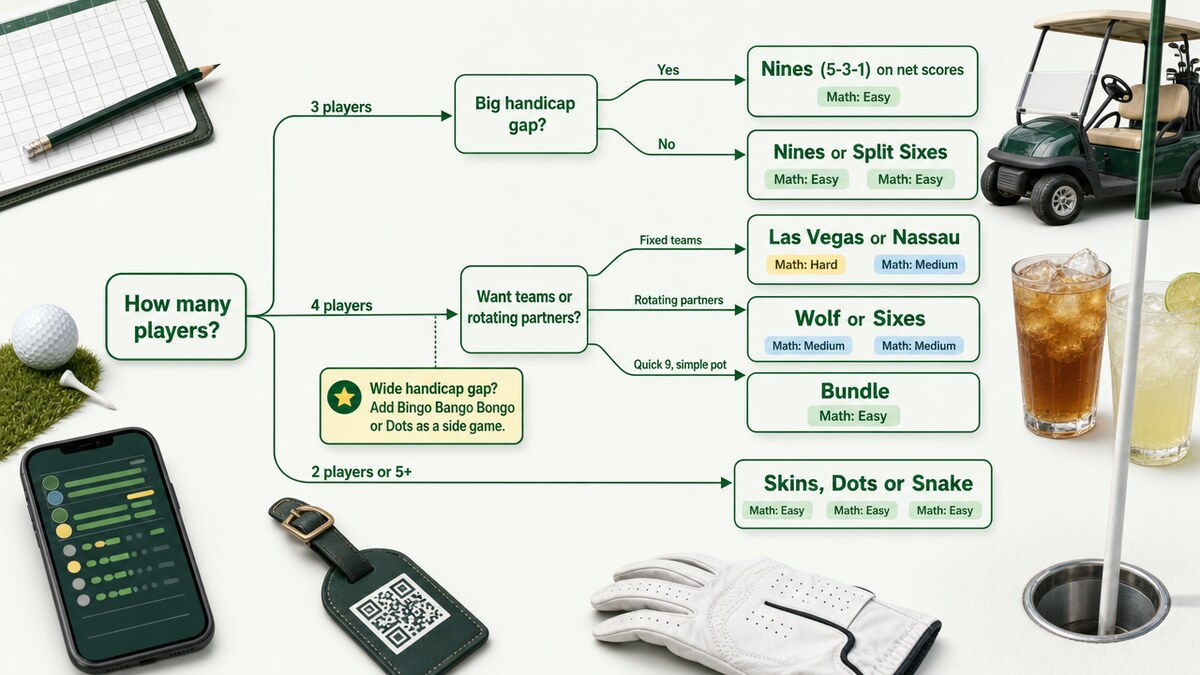
The best golf betting game for your friends depends on how many of you are playing.
- Threesome: Nines (5-3-1) or Split Sixes.
- Foursome: Wolf, Las Vegas, Sixes, a Nassau or Bundle.
- Any group size: Skins, Dots or Snake.
- Wide handicap gaps: Nines or Bingo Bango Bongo, played on net scores.
Below, each game gets a plain rating for how hard the math is and how messy the settle-up gets. You'll also find suggested stakes, the most you can lose, and how to net several bets into a few payments. One note before we start: this page is general information about formats, not legal or financial advice. Rules on betting vary by place, so check with a qualified professional if you're unsure what applies where you play.
On this page
- Why play a side game at all
- How to read the ratings
- Games for three players
- Games for four players
- Games that work at any group size
- Games for mixed handicaps
- Worst-case loss at common stakes
- Running several games at once: settling with fewer payments
- Agree on the rules before the first tee
- What Green Math scores today, and what's coming
- Frequently asked questions
Why play a side game at all
A side game gives every hole a reason to matter. You might be out of the match by the 12th. You can still win the hole, steal the bundle or pick up a greenie.
Side games also level a group. Formats that reward being first, closest or steadiest give a 20-handicap a real shot against a 6. And the stakes don't have to be money. Golfers have bet on rounds for well over a century, and plenty of groups still play for the first round of drinks or bragging rights.
The catch is always the math. Each game below is rated so you know what you're signing up for.
How to read the ratings
Math is how hard the scoring is during the round.
- Easy: You can do it in your head.
- Medium: You'll want to write things down.
- Hard: Someone ends up as the designated accountant.
Settle-up is how complicated paying out is afterward.
- Simple: One pot or one number.
- Moderate: Totals measured against the group average.
- Messy: Several separate bets to net out.
Games for three players
Threesomes are awkward for most team games. These two formats were built for exactly three.
Nines (5-3-1)
Each hole is worth 9 points. The low score gets 5, the middle gets 3 and the high gets 1.
Ties split the points:
- Two players tie for low: 4-4-1.
- Two players tie for middle or high: 5-2-2.
- All three tie: 3-3-3.
An optional Blitz rule gives all 9 points to a player who beats the second-best score by 2 or more strokes.
- Math: Easy. Every hole adds up to 9, so totals are easy to check.
- Settle-up: Moderate. Multiply points by the stake, then compare each player to the average.
- Suggested stakes: $0.25 to $0.50 a point for a casual group, $1 to $2 for a bit more bite.
- Why it works: You always earn at least a point. Steady golf beats the occasional birdie.
Full rules, tie examples and a worked settlement are on the Nines rules page.
Split Sixes
Split Sixes works like Nines with a smaller pot. In the most common version, each hole is worth 6 points:
- Low gets 4, middle gets 2 and high gets 0.
- Two players tie for low: 3-3-0.
- Two players tie for high: 4-1-1.
- All three tie: 2-2-2.
House rules vary, so confirm the splits before you tee off.
- Math: Easy.
- Settle-up: Moderate. It's the same average-based method as Nines.
- Trade-off: The high score gets nothing, so a bad hole costs more than in Nines. Pick Split Sixes if your threesome wants a little more punishment for blow-ups.
Games for four players
Most classic side games assume a foursome. Here are five, from most strategic to simplest.
Wolf
Wolf rotates through the tee order, so each player is the Wolf once every four holes. After watching the tee shots, the Wolf has three choices:
- Pick a partner for the hole.
- Go Solo against the other three.
- Declare Lone Wolf before anyone hits.
Each team plays best ball. A common points scale:
- Wolf and partner win: 2 points each.
- Solo Wolf wins: 3 points.
- Lone Wolf wins: 4 points.
- Wolf loses: each defender gets 1 point.
Some groups pay winning defenders more, so settle the scale up front.
- Math: Medium. The points are simple, but tracking who partnered whom on which hole gets confusing by the back nine.
- Settle-up: Moderate. Total the points and compare each player to the group average.
- Suggested stakes: $0.50 to $1 a point for casual play, $2 to $5 for moderate.
- Why it works: Every hole involves a decision, and the decisions start the arguments.
See the Wolf rules and strategy page for rotation charts and settlement examples.
Las Vegas
Two fixed teams of two combine their scores into a two-digit number, low score first. A 4 and a 5 make 45. The lower team number wins the difference in points.
Two rules make Vegas swing:
- Double digits: If anyone scores 10 or more, that score goes first. A 7 and a 10 becomes 107, not 710.
- Flip the Bird: Many groups play that a birdie reverses the other team's digits.
- Math: Hard. It's easy to pair numbers wrong and miss a flip.
- Settle-up: Simple to moderate. You settle on one team point difference, but that number can get big.
- Suggested stakes: $0.10 to $0.25 a point for casual play. Keep it small, because one disaster hole can be worth 70 points.
- Why it works: You're never out of it. One birdie can erase three bad holes.
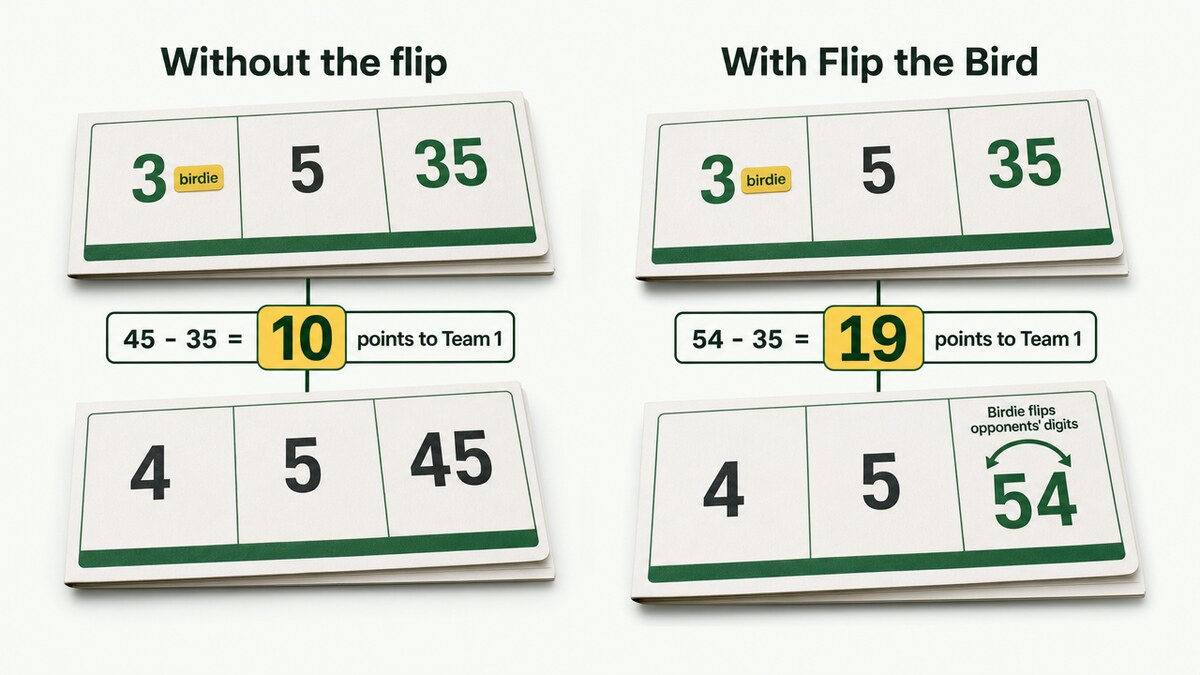
Our Las Vegas rules page walks through pairing rules, pushes and the flip in detail.
Sixes (Round Robin)
Partners rotate every six holes, so each player teams with each of the other three once. Every six-hole stretch is its own bet, and you can score each stretch with any format, usually best ball.
- Math: Medium. The scoring is simple, but you're tracking three separate matches.
- Settle-up: Messy. You have three results to net, and they often half cancel out.
- Why it works: Nobody gets stuck with a bad partner for 18 holes.
Nassau
A Nassau is three bets in one: the front nine, the back nine and the full 18. It dates to 1900 at Nassau Country Club on Long Island. It was designed so a lopsided loss wouldn't look so bad in print.
Many groups add presses, which are new side bets a trailing player can start mid-nine.
- Math: Medium. Without presses it's easy. Each press is one more match to track.
- Settle-up: Moderate to messy, depending on how many presses you allow.
- Suggested stakes: A $2 Nassau is the classic friendly game. In a foursome, the most a player can lose is $6. A player who sweeps all three bets collects $18.
- Why it works: A bad front nine doesn't end your day. Two bets are still alive.
Bundle
Bundle suits a twilight nine. Everyone antes into one pot, and Player 1 starts holding the bundle. It passes to the next player in the tee order on any of these:
- Out of bounds.
- A penalty area.
- Double bogey or worse.
- A three-putt.
If an opponent makes birdie, the bundle goes straight to that player. Whoever holds it at the end wins the pot. Over 18 holes, the pot splits in half, with one half to the holder after hole 9 and one half to the holder after hole 18.
- Math: Easy. There are no points, just a holder.
- Settle-up: Simple. It's one pot.
- Suggested stakes: A $5 to $10 ante for a relaxed nine.
- Why it works: The pressure is on the holder, and everyone else gets to enjoy it.
Penalty-event details and pot split examples are on the Bundle rules page.
Games that work at any group size
These three work for a twosome, a foursome or a 12-player outing. They also stack on top of any main game.
Skins
Each hole is worth a skin. The lowest score wins it outright. If players tie, the skin carries over to the next hole, so pots can build quickly.
- Math: Easy.
- Settle-up: Simple. Count each player's skins, then multiply by the value.
- Decide up front: Gross or net. Also decide whether skins still tied after 18 get split, replayed or dropped.
Dots (Junk, Garbage, Trash)
Dots are points for achievements rather than score. Common dots include:
- Greenie: Closest to the pin on a par 3, on the green.
- Sandy: Par or better after being in a bunker.
- Barkie: Par or better after hitting a tree.
Agree on the full list before you start, because groups add their own.
- Math: Easy.
- Settle-up: Simple to moderate. Each dot is usually paid by every other player.
- Why it works: A high handicapper can collect just as many dots as a scratch player.
Snake
The snake goes to whoever three-putts. It passes to the next player who three-putts, and whoever holds it at the end pays.
House rules we'd suggest so nobody gets surprised:
- Set a fixed snake value.
- If the value grows with each three-putt, set a cap.
- Agree whether a putt from off the green counts.
- Math: Easy.
- Settle-up: Simple. One person pays.
- Good starter bet: If your group is new to side games, Snake or a closest-to-the-pin bet on par 3s is a low-key way to start.
Games for mixed handicaps
If your group spans 5 to 25, you have two options. You can pick formats that don't depend on raw scoring, or you can play net.
Formats that help on their own:
- Nines: It rewards steadiness, and you never leave a hole empty-handed.
- Bingo Bango Bongo: You earn a point for being first on the green, closest once everyone is on, or first in the hole. A weaker player who chips close after more strokes can still win the closest point.
- Dots and Bundle: Big scores cost less than they do in stroke-based games.
Playing net: Agree on strokes before the first tee, then score net. Common reference points under the World Handicap System:
- Singles match play uses 100% of the handicap difference. The lowest player plays off zero, and everyone else gets the difference. For example, a player with a Course Handicap of 10 playing someone with a Course Handicap of 18 gives that player eight strokes.
Four-ball match play uses 90% of each player's difference from the lowest player, who plays off zero. The WHS doesn't cover games like Vegas or Wolf, but some groups use this figure as a starting point for best-ball team bets.
- Four-ball stroke play uses 85%.
- For net skins, the World Handicap System makes no recommendation on how to allocate strokes. A simple house approach is to use full strokes on the hardest-rated holes. Whatever you choose, announce it before anyone tees off.
Check everyone's handicap on the first tee. A wrong number found on 16 ruins the settle-up and the friendship.
Worst-case loss at common stakes
This is the question most people actually have: how bad can it get? Here's the ceiling for one player at typical friendly stakes.
| Game | Example stakes | Worst case for one player | Ceiling? |
|---|---|---|---|
| Nassau (foursome) | $2 per bet | $6 | Yes, unless you press |
| Bundle | $10 ante | $10 | Yes, your ante |
| Skins | $1 per skin per player | $18 over 18 holes | Yes |
| Nines | $0.50 a point, no Blitz | About $18 (all 1s against an average of 54) | Yes |
| Las Vegas | $0.10 a point | $7.20 on a single 35-vs-107 hole, with no fixed limit for the round | No |
| Wolf | $1 a point | Depends on how often others win Lone and Solo Wolf | Soft |
The takeaway: Nassau, Bundle and Skins have hard limits. Vegas doesn't, which is why its suggested stakes are measured in dimes.
Running several games at once: settling with fewer payments
Plenty of foursomes play a Nassau, Skins and Dots together. If you settle each game separately, players can end up sending a dozen small payments. Net everything first.
Step 1: Total each game per player. Pluses and minuses must sum to zero.
| Player | Nassau | Skins | Dots | Net |
|---|---|---|---|---|
| A | +8 | -3 | +1 | +6 |
| B | -2 | +9 | -2 | +5 |
| C | -2 | -3 | +3 | -2 |
| D | -4 | -3 | -2 | -9 |
Step 2: Pay off the biggest debts first.
- D pays A $6.
- D pays B $3.
- C pays B $2.
That's three payments instead of a pile of crisscrossing ones. For a foursome, three is usually the minimum. For a group that pays by phone, it's the difference between settling at the cart and settling on Tuesday.
Agree on the rules before the first tee
Most side-game arguments happen because something wasn't decided up front. Take two minutes on the first tee and agree on:
- Gross or net, and how many strokes each player gets.
- Presses: Allowed or not, when they can start, and whether a press can itself be pressed.
- Carryovers: Whether tied skins carry, and what happens to skins still tied after 18.
- Vegas specifics: Whether Flip the Bird is on, and whether partners switch at the turn.
- Wolf scale: What defenders earn when they beat the Wolf.
- Gimmes: What counts as a gimme, and whether gimmes count for Snake and three-putt penalties.
- Maximum hole score: A cap such as double par keeps one disaster from deciding the whole day.
- Stakes and payment method: Decide before anyone swings.
Write it down or put it in whatever you use to score.
What Green Math scores today, and what's coming
Green Math is a scoring and settlement tool. It doesn't book tee times, give lessons or handle anyone's money.
Scored now:
- Free, every game: Wolf (Lone, Solo and Partner), Nines (5-3-1), Las Vegas with Flip the Bird, Bundle, Left/Right and Bingo Bango Bongo, with full scoring, settlements and round history.
On the roadmap, not available yet:
- Coming soon: Nassau, Skins, Match Play and Dots.
- In development: Sixes (listed as 6-6-6) and Stableford.
- Side bets on the list: Snake.
Split Sixes isn't on the list yet. Until these games ship, score them on paper using the rules above.
How a round works:
- One person creates a free account, picks the game and point values, and shares a QR code.
- Everyone else joins in their phone's browser. They don't need an app, and following along needs no account.
- Players enter their own scores (anyone entering scores signs up free), and the leaderboard updates as you go.
- At the end, a settlement matrix shows who pays whom in the fewest transactions.
Create a free account and score your next round. Every game is free, with no credit card.
Frequently asked questions
What's the easiest golf betting game for beginners?
Snake or a closest-to-the-pin bet on par 3s. Each has one rule, and one person pays. If you want a full-round game, Nines for a threesome or Bundle for a foursome is easy to explain on the first tee.
What's the best golf betting game for 4 players?
It depends on the group:
- Strategy and table talk: Wolf.
- Big swings with fixed teams: Las Vegas at small stakes.
- A known worst case: A Nassau.
- A quick nine with one pot: Bundle.
Can you play more than one side game at once?
Yes, and many groups do, usually a main game plus Skins or Dots. Total each game per player, add the totals into one net number, and settle that. The worked example above shows how a foursome gets down to three payments.
How do handicaps work in golf side games?
Agree on strokes before the round and score net. Common practice is full strokes for one-on-one matches and a reduced share for best-ball team games. There's no official standard for net skins, so pick a house rule and announce it.
Do my friends need to download an app to use Green Math?
No. It runs in any phone's browser. Anyone can scan the QR code and follow the live leaderboard with no account. Entering scores takes a free account, or one person can keep score for the whole group.
Does Green Math need my GHIN number or GPS?
No. It doesn't connect to handicap services or track GPS. Handicaps are optional: pick a course and tees and Green Math allocates strokes by stroke index, or skip the course and enter net scores. Either way, Green Math does the scoring and settlement math.