
Golf Dots Rules: Points, Penalties and How to Settle Up
Golf Dots is a side game where you earn points for good shots, such as greenies, sandies, barkies, chip-ins and birdies, and lose points for mistakes like three-putts, water balls and out of bounds. Each player keeps a running total of dots. At the end of the round you compare net dots and pay the difference at a per-dot value your group agrees on.
There is no official rule set. Every group picks its own dots and values before the first tee. This page gives you a sample table you can adopt as-is, the rulings worth agreeing on in advance, and a worked settlement for 2 to 6 players.
On this page
What the different names mean
You'll hear this game called several things. Most of them overlap.
- Dots: The name comes from marking a dot on the scorecard next to the score.
- Junk: The common catch-all for extra bets added on top of a main game like Nassau, Skins or Vegas.
- Trash and Garbage: Same idea as Junk. These are regional names more than different games.
- Trouble or Disaster: Usually a penalty-only version. Players collect points for mistakes, and the fewest points wins.
- Nasties or Uglies: Usually a narrower bet. It pays for holing out from off the green.
If someone in your group grew up with a different name, the name doesn't matter. Confirm which dots count, whether bad dots exist, and what a dot is worth.
How to play Dots
- Agree on the list. Decide which positive and negative dots count and what each is worth.
- Set a value per dot. Pick a dollar figure or play for bragging rights.
- Play your normal round. Dots runs alongside whatever else you're playing, or on its own.
- Mark dots as they happen. Note them hole by hole so nobody has to reconstruct the round in the parking lot.
- Net it out at the end. Each player's total is positive dots minus negative dots. Then settle the differences.
Positive dots
- Greenie: Hitting the green in regulation, or closest to the pin on a par 3, depending on your house rule.
- Sandy: Getting out of a bunker and still making par.
- Barkie: Hitting a tree and still making par. A Double Barkie is two trees and still par.
- Chippie (chip-in): Holing out from off the green.
- Fishie: Making par on a hole where your ball went in the water.
- Birdie and eagle: Usually worth more than the scrambling dots.
Negative dots
- Three-putt: Three or more putts once you're on the green.
- Water: Any ball into a penalty area.
- OB: Any ball out of bounds.
Sample Dots point table
These are sample values, not a standard. They're simple enough to tally in your head and balanced enough that one bad hole doesn't wipe out a good round.
| Dot | What earns it | Sample value |
|---|---|---|
| Greenie | Green in regulation (or closest on par 3s) | +1 |
| Sandy | Out of a bunker, par or better | +1 |
| Barkie | Hit a tree, par or better | +1 |
| Double Barkie | Hit two trees, par or better | +2 |
| Chippie | Hole out from off the green | +1 |
| Fishie | Water ball, par or better | +1 |
| Birdie | One under par | +2 |
| Eagle | Two under par | +4 |
| Three-putt | Three or more putts | −1 |
| Water | Ball in a penalty area | −1 |
| OB | Ball out of bounds | −1 |
If your group wants more swing, double the birdie and eagle values. If you want less chaos, drop the negative dots and play positives only.
Rulings to agree on before you tee off
Most Dots arguments come from a dot the group never defined. Settle these five on the first tee.
Does a dot need par or better?
Sandies, barkies and fishies usually require par. Decide whether that means gross par or net par. Net par opens the scrambling dots to higher handicappers. Handicap strokes fall on the holes ranked by the stroke index (handicap) row on the scorecard, so a player with a Playing Handicap of 14 gets a stroke on the holes ranked 1 through 14. Use the handicap for the course and tees you're playing, not your Handicap Index, and if your group plays off the low player, count strokes from the difference.
Greenies: closest to the pin or every green in regulation?
Closest-on-par-3s gives four or so greenies a round, and only one player wins each. Every-GIR pays out more often but favors strong ball-strikers. Green in regulation means reaching the green in two strokes fewer than par: one on a par 3, two on a par 4, three on a par 5. Mixed groups often use closest-on-par-3s, or give higher handicappers an extra stroke toward reaching the green.
Does the fringe count as off the green for a chip-in?
Under the Rules of Golf, a ball is on the putting green only when it touches the green surface. The fringe and apron are part of the general area. By that definition, holing out from the fringe is a chip-in. Some groups won't pay a chippie if a putter was used, so decide this one ahead of time.
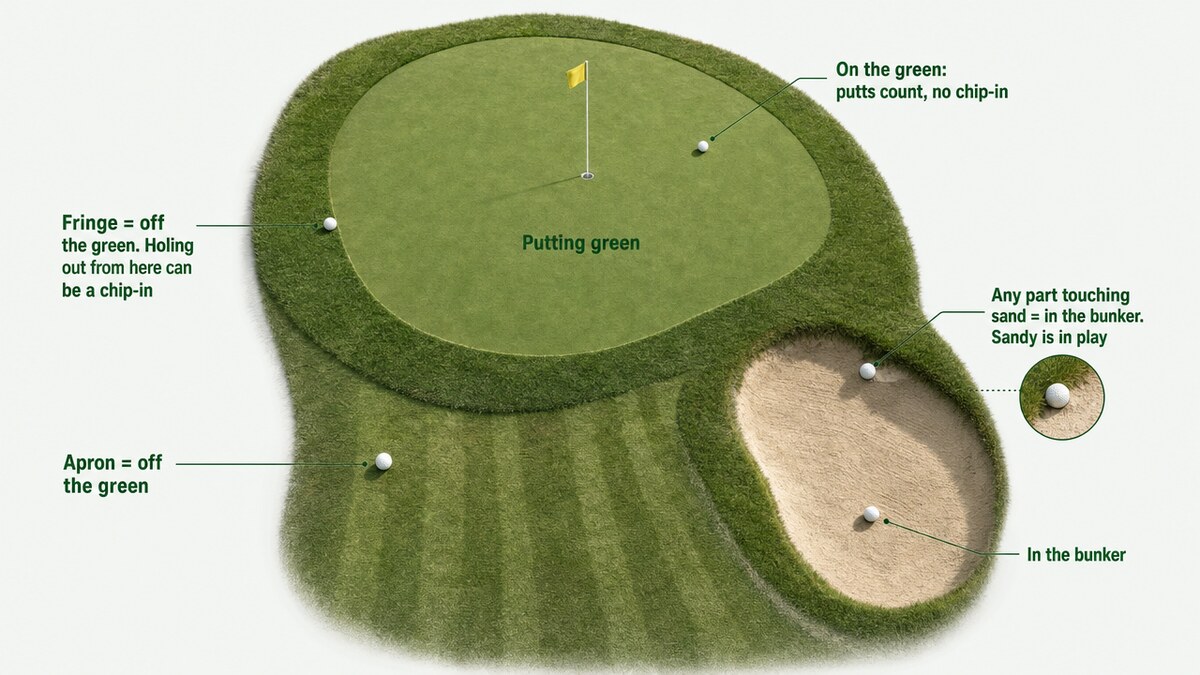
What counts as in the bunker for a sandy?
Under the Rules of Golf, a ball is in a bunker when any part of it touches sand inside the edge of the bunker, or when it rests inside the edge where sand would normally be. A ball sitting on a grass lip or bank without touching sand is not in the bunker. Some groups also require the bunker shot to be greenside, so a fairway bunker followed by a par doesn't pay.
Do negative dots stack on one hole?
If you hit into water and then three-putt, is that −1 or −2? Stacking is harsher but simpler to apply. A per-hole cap of −2 keeps one ugly hole from deciding the day.
Also agree on mulligans and gimmes before you start. The formal Rules of Golf don't allow players to agree to ignore a rule or penalty they know applies, and players who do can be disqualified. In a casual game, settle your house rules up front so nobody is making them up mid-round.
Why Dots works for high handicappers
Stroke-based bets reward whoever shoots the lowest number. Dots rewards moments. A 22-handicap who chips in, saves par from a bunker, or bounces one off a tree and still makes four collects the same dot as a scratch player.
Point games like this are good equalizers because they pay specific shots, not total strokes. A weaker player who chips close can win a point after taking more strokes than a stronger player with a long birdie putt.
Three tweaks make it even fairer for mixed groups:
- Net scoring for par-dependent dots. Use net par for sandies, barkies and fishies.
- Net birdies. Pay birdie dots on net score, so handicap strokes count.
In casual rounds you can pick up once you reach net double bogey and still post the score, recording net double bogey for that hole. If you don't have a Handicap Index yet, the limit is par plus 5. Pace stays reasonable, and a high handicapper isn't grinding out an 9 just to avoid a three-putt dot.
How to settle net dots
Each player's net dots are their positive dots minus their negative dots. There are two common ways to turn those totals into money. Pick one before the round. They produce very different amounts.
Method 1: Pairwise
Every player settles with every other player on the difference between their totals.
Payout for a player = (their dots × number of players − total dots in the group) × value per dot
Method 2: Against the average
Each player wins or pays the gap between their dots and the group average.
Payout for a player = (their dots − group average) × value per dot
Pairwise pays out exactly as many times more as there are players in the group. In a foursome, pairwise moves four times the money of the average method at the same per-dot value.
Worked example: four players, $1 per dot
Final net dots: Ana +6, Ben +3, Cal +1, Dev −2. The total is 8 and the average is 2.
| Player | Net dots | Pairwise | Against average |
|---|---|---|---|
| Ana | +6 | wins $16 | wins $4 |
| Ben | +3 | wins $4 | wins $1 |
| Cal | +1 | pays $4 | pays $1 |
| Dev | −2 | pays $16 | pays $4 |
Here's how Ana's pairwise figure works: she beats Ben by 3, Cal by 5 and Dev by 8, for $16.
The same math works for any group from 2 to 6 players. With two players, both methods reduce to paying the difference. With six, pairwise gets big quickly, so lower the per-dot value or use the average method.
Fewer payments, same result
Pairwise settling between four players means six separate debts. You don't need six payments. Net everything out and only two transfers are needed: Dev pays Ana $16 and Cal pays Ben $4.
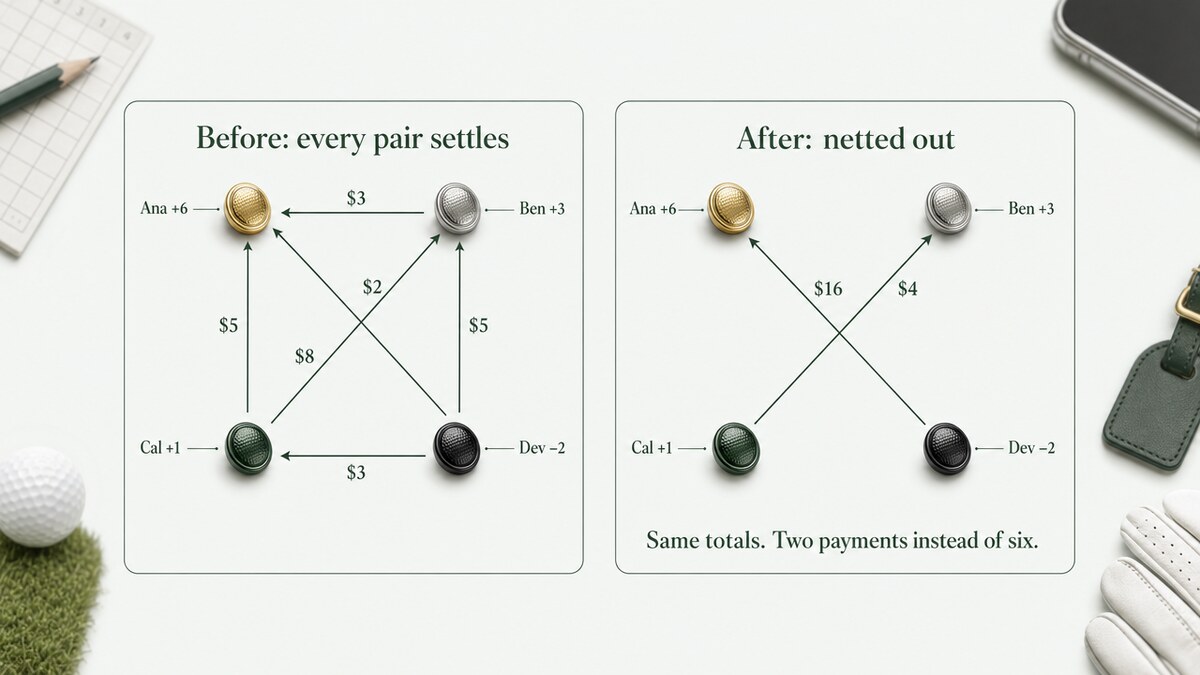
Green Math's settlement matrix already does this for Wolf, Nines and Las Vegas. It shows who pays whom with the fewest transactions.
This page is general information about a casual game, not financial or legal advice. If you have questions about playing for money where you live or play, check with a qualified professional.
Recording dots and stacking with other games
On a paper card, mark a dot beside the score for each positive and an X for each negative. Total both columns at the turn and at the end. It works, but someone has to remember to do it on every hole.
With other games, decide where dots overlap so nothing pays twice:
- Las Vegas: A birdie already flips the opponents' number. Decide whether it also pays a birdie dot, or drop birdies from your Dots list.
- Skins: A birdie that wins a skin can still earn a birdie dot, but say so up front.
- Wolf or Nassau: Dots usually stays individual even when the main game is played in teams.
- Nines: Dots adds individual action to a threesome without touching the 5-3-1 math.
If your group likes the penalty side of Dots, try Bundle. It's a single pot that passes on OB, water, double bogeys, three-putts and opponents' birdies. Whoever's holding it at the end collects.
Dots in Green Math: coming soon
Dots isn't in Green Math yet. It's on the roadmap under Coming Soon, alongside Nassau, Skins and Match Play. Until it arrives, use the table above and a pen.
In the meantime, Green Math scores Wolf, Nines and Las Vegas automatically, with a live leaderboard and a minimum-transaction settlement at the end. One person creates the round and everyone else scans a QR code. Nobody downloads anything, and it's all free.
Create your free account and let the app do the math on your next round.
Frequently asked questions
Is there an official set of Dots rules?
No. Dots, Trash, Garbage and Junk are house games. Use the sample table here or build your own. What matters is that your group agrees before the first tee.
How many players can play Dots?
The game works for 2 to 6 players. With more players, pairwise settling grows fast, so consider a smaller per-dot value. Green Math's roadmap currently lists Dots for 2 to 4 players.
Should dots be gross or net?
Either works. Gross is simpler. Net par and net birdies make sandies, barkies and birdies reachable for higher handicappers, which keeps mixed groups competitive.
What's the difference between Dots and Trouble?
Dots usually counts both good and bad shots. Trouble, also called Disaster, typically counts only mistakes, and the player with the fewest points wins.
Can I play Dots without a main game?
Yes. Many groups play Dots on its own, especially mixed-skill groups where a stroke-based bet would be lopsided.
Can I track Dots in Green Math now?
Not yet. It's listed as Coming Soon on the roadmap. Wolf, Nines and Las Vegas are available today.