
How to Play Nassau Golf: Front, Back, Total and Presses
A Nassau is three bets in one round: the front nine, the back nine and the full 18, usually for the same stake. In the classic match play version, you win a hole by taking fewer strokes (net, if you're using handicaps), and whoever wins more holes in each segment wins that bet. Presses are extra bets started mid-round, usually by the player who falls 2 down. Presses are also where the settlement gets messy.
This page covers the rules, the press variations you need to agree on before the first tee, how handicap strokes split across the nines, and a full $5-5-5 example with a running ledger and final net amount.
The game dates to 1900. J.B. Coles Tappan of Nassau Country Club on Long Island split matches into three parts so the worst result anyone could suffer was 3-0, which spared members lopsided scores in the local paper. The USGA calls it arguably the most popular golf betting game.
On this page
The three-bet structure
A "$5 Nassau" or "$5-5-5" means:
- Front nine (holes 1–9): $5
- Back nine (holes 10–18): $5
- Overall 18: $5
Each bet is settled on its own. You can lose the front, win the back and take the overall, so a bad start doesn't sink your day. That's the point of the format.
Some groups weight the bets differently, such as $5-5-10, so the full round counts for more. The structure stays the same.
Match play vs. stroke play Nassau
Match play (the default). Each hole is won, lost or halved. You win a segment by winning more holes in it. In match play you've won once your lead is bigger than the number of holes left. That's why you hear results like "3 and 2." In a Nassau, the holes after a bet closes still matter, because the other bets and any presses keep running.
Stroke play. Lowest total score (gross or net) for each nine and for 18 wins the bet. It's simpler to score but less dramatic, since one blow-up hole can decide a whole side. Ties push. Presses are rare in stroke play Nassaus because there's no clean "2 down" trigger.
Presses: the part to agree on before teeing off
A press is a new bet that starts on the next hole and runs alongside the original. It's usually for the same amount and usually lasts until the end of the nine you're on. The original bet keeps going too. You're now playing two matches at once over the same holes.
Manual press
The player who is behind calls it. Before the round, decide:
- Can the leader refuse? In many groups the leader must accept. In others it's optional. Pick one.
- How far down do you have to be? Commonly 2 down. Some groups allow a press at 1 down.
Auto press (the 2-down press)
A press starts automatically whenever a player falls 2 down. Nobody has to call it, and nobody can refuse. The detail that causes arguments is which bet triggers it. The common rule: a new auto press starts when you fall 2 down in the most recent bet on that nine. Falling back to 2 down in the original bet doesn't start another one if a newer press is open.
Press the press
When you fall 2 down in a press, you can press that press. Now three bets cover the same holes. With auto presses, this happens on its own. This is how a $5 Nassau turns into a $40 afternoon.
Air press
The definition varies more than any other. In most groups, an air press is one called while a ball is still in the air, typically after seeing an opponent's tee shot heading for trouble. Because it's opportunistic, groups that allow it usually let the other side decline. Plenty of groups ban it outright. Settle it before the round, not on the 14th tee.
Closing press (last-hole press)
A press on the final hole of a nine, usually 18 and sometimes 9 as well. It's a one-hole bet that gives the trailing player a last shot at getting money back. Some groups double the stake on a closing press. Agree on the amount up front.
Can you press the 18-hole bet?
Many groups don't, and most presses stay inside their own nine. Some allow a back-nine press to count toward the overall too. Whatever you choose, write it down.
First-tee checklist
- Stake for each bet ($2-2-2, $5-5-5, etc.)
- Match play or stroke play
- Manual presses, auto presses at 2 down, or both
- Can the leader refuse a manual press?
- Is press the press allowed?
- Air press: allowed, optional or banned?
- Closing press on 9 and/or 18, and at what stake?
- Do presses end at the turn, or can any carry to 18?
- Everyone's strokes, confirmed out loud
Handicap strokes in a Nassau
Play off the low player. In singles match play, the lower handicap plays from scratch and the higher handicap gets the full difference in Course Handicap. Strokes then fall on the holes where the higher handicap needs them most.
Four-ball (2v2) allowance. The USGA recommends 90% of Course Handicap for four-ball match play, again playing off the low player. In its example, players at 10, 18, 27 and 39 get 0, 8, 17 and 29 strokes in singles against the 10, or 0, 7, 15 and 26 in four-ball at 90%. For a stroke play Nassau, the USGA's recommended individual stroke play allowance is 95%, though that figure is designed for larger fields and small groups can reasonably agree to use 100%.
How strokes split between the nines. On most cards, the odd-numbered stroke index holes are on the front and the even ones on the back. That's deliberate, and it spreads strokes fairly evenly across the front and back bets. A player getting 4 strokes would usually get two per side. Check your card anyway. Some courses switch the order when the back nine is much harder. If one nine is light on stroke holes for your match, agree how to handle it before you start.
Separate nine-hole matches. When strokes are taken for nine holes on an 18-hole course, they normally go in ascending order from the published 18-hole stroke index, though some courses publish a separate 1-to-9 order for each nine. If your group uses 9-hole handicaps for each side, confirm everyone's numbers before teeing off.
Confirm strokes on the first tee every time. Most press arguments are really handicap arguments in disguise.
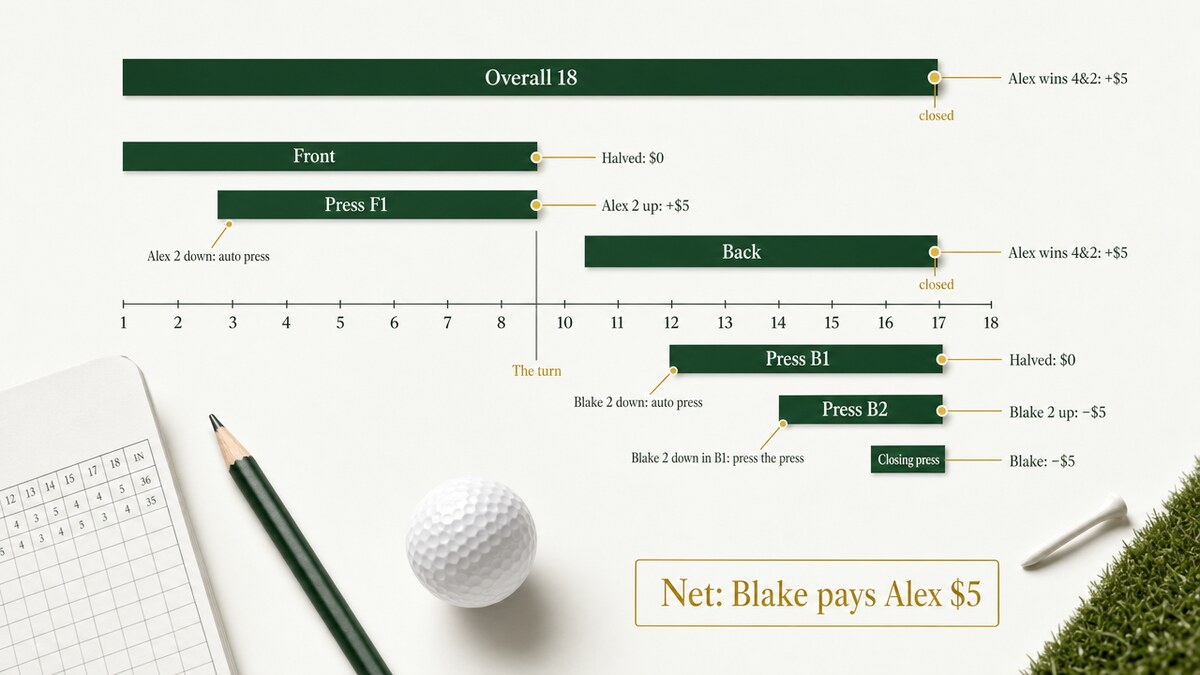
Worked example: $5-5-5 with presses
Players: Alex vs. Blake, singles match play, strokes already applied.
Rules agreed on the first tee: $5 per bet. Auto press at 2 down in the most recent bet on that nine. Presses end at the end of their nine. The 18-hole bet can't be pressed. Closing press on 18 for $5.
Status is shown from Alex's side.
Front nine ledger
| Hole | Winner | Front bet | Press F1 (from 3) |
|---|---|---|---|
| 1 | Blake | 1 down | — |
| 2 | Blake | 2 down | auto press starts |
| 3 | Alex | 1 down | 1 up |
| 4 | Halved | 1 down | 1 up |
| 5 | Blake | 2 down | All square |
| 6 | Alex | 1 down | 1 up |
| 7 | Halved | 1 down | 1 up |
| 8 | Halved | 1 down | 1 up |
| 9 | Alex | All square | 2 up |
On hole 5, Alex is back to 2 down in the front bet, but no new press starts. The most recent bet is F1, and Alex is all square in that one. The front bet ends tied, so it pushes and nobody pays. Alex wins F1.
Back nine ledger
The overall bet is all square after nine.
| Hole | Winner | Back bet | Press B1 (from 12) | Press B2 (from 14) | Overall 18 |
|---|---|---|---|---|---|
| 10 | Alex | 1 up | — | — | 1 up |
| 11 | Alex | 2 up | Blake's auto press starts | — | 2 up |
| 12 | Alex | 3 up | 1 up | — | 3 up |
| 13 | Alex | 4 up | 2 up | press the press starts | 4 up |
| 14 | Blake | 3 up | 1 up | 1 down | 3 up |
| 15 | Halved | 3 up | 1 up | 1 down | 3 up |
| 16 | Alex | Won 4&2 | 2 up | All square | Won 4&2 |
| 17 | Blake | — | 1 up | 1 down | — |
| 18 | Blake | — | All square | 2 down | — |
Blake also calls the closing press on 18 and wins the hole.
The back bet and the overall both close out on 16. The holes still matter because two presses are open. B1 ends all square, so it pushes, just like a tied main bet.
Settlement
| Bet | Result | Alex |
|---|---|---|
| Front | Halved | $0 |
| Press F1 (holes 3–9) | Alex, 2 up | +$5 |
| Back | Alex, 4&2 | +$5 |
| Press B1 (holes 12–18) | Halved | $0 |
| Press B2 (holes 14–18) | Blake, 2 up | −$5 |
| Closing press (18) | Blake | −$5 |
| Overall 18 | Alex, 4&2 | +$5 |
| Net | +$5 |
That's seven bets and $35 in play, and one payment: Blake pays Alex $5. Settle each bet in a column like this, then net it to a single number. Don't hand money back and forth bet by bet.
Foursomes: everyone vs. everyone, or 2v2
Round robin. Each player has a separate Nassau with each of the other three. That's six matches in a foursome. In a $2 Nassau without presses, you risk $6 against any one opponent. Win all three bets against all three opponents and you collect $18, which is $6 from each player. Presses multiply all of this. Total each player's results across their three matches, then settle the net amounts with as few payments as possible.
2v2 team Nassau. Usually played as best ball. The lower net score on each side counts for the hole, using the four-ball allowance. Most groups have each player on the losing side pay the stake to a player on the winning side, so each person's exposure per bet equals the stake. Confirm that, because some groups split the stake per team instead.
Stakes and etiquette
- Typical stakes: $2-2-2 is a friendly game. $5-5-5 is the classic weekend Nassau. Remember that presses can multiply your real exposure several times over.
- Agree on press rules before the first tee. Use the checklist above.
- Keep the press count on the card. Write a mark at the hole where each press starts. One person keeps the official ledger.
- Pay promptly. Settle at the 19th hole, not next Saturday.
- Keep it reasonable. USGA guidance treats informal betting as acceptable when players generally know each other, nobody is required to join, and all winnings come from the players themselves. This page is general information. Rules on wagering vary by location, so check with a qualified professional if you're unsure what applies where you play.
- Common mistakes: forgetting that a halved bet or press pushes, starting an auto press off the wrong bet, and quitting the holes after a bet closes while presses are still open.
Many groups add junk bets on top, such as greenies, sandies, barkies and chip-ins. Keep those in a separate column so the Nassau math stays clean.
Nassau is coming to Green Math
Nassau is on the Green Math roadmap under Coming Soon. It isn't something Green Math scores yet, so for now a pencil and the ledger above will do the job.
What Green Math handles today is Wolf, Nines (5-3-1) and Las Vegas. Players join from a QR code on their own phones and sign up free to score themselves. A live leaderboard runs all round, and a settlement matrix shows who pays whom in the fewest transactions. All of them are free.
Create a free account and start your next round.
Frequently asked questions
What is a press in a Nassau?
A press is a new bet, usually for the same stake, that starts on the next hole and runs alongside the original bet. It typically lasts until the end of the current nine. The player who is behind calls it, or it starts automatically at 2 down if your group plays auto presses.
Can the player who's ahead refuse a press?
It depends entirely on what your group agrees. Many groups require the leader to accept a manual press, some make it optional, and auto presses can't be refused by definition. Decide on the first tee.
What happens if a press ends all square?
It pushes, the same as a tied front, back or overall bet. Nobody pays on it.
Do front-nine presses carry into the back nine?
Usually not. Most groups end every press at the turn, then start the back nine fresh with only the back and overall bets running. A few groups let presses run to 18, which is fine as long as everyone knows.
How are handicap strokes split between the front and back bets?
On most scorecards, odd stroke index holes are on the front and even ones on the back, so strokes fall roughly evenly per side. Play off the low player in match play and check your card for any unusual split.
Does Green Math score Nassau yet?
Not yet. Nassau is listed as coming soon on the roadmap. Today you can use Green Math for Wolf, Nines and Las Vegas, all free.