
How to Play the Hammer in Golf (Plus Let It Ride, Closeout and Other Doubling Bets)
In the Hammer, any side can "hammer" during a hole to double that hole's bet. The other side must either accept and play on at the doubled stake, or concede and pay the stake as it stood before the hammer. Only the side that was just hammered can hammer back, ties don't carry over, and every hole starts fresh at the base bet.
The rules fit in three sentences. The money math is harder to track. Below are the rules, a worked dollar example, the related doubling bets your group may run into, and the agreements that keep a friendly game from getting out of hand.
On this page
- Core Hammer rules
- How stakes double and re-double
- Cube and On the Spot
- Let It Ride and Closeout
- Murphy and Nicklaus call bets
- Using the Hammer on top of Wolf or Nassau
- Set caps so friendly stakes stay friendly
- Etiquette disputes to settle before the first tee
- How to settle a hammered round accurately
- Frequently asked questions
Core Hammer rules
Most groups play the Hammer as a two-sided, hole-by-hole match. That means one player against another, or two teams of two.
- Base bet. Agree on a per-hole amount per player before the first tee, such as $1 or $2.
- Who can hammer. Either side can throw the first hammer on a hole. After that, only the side that was hammered can hammer back. You can't hammer twice in a row.
- When. Usually any time after the hole starts and before it's decided. Many groups require the hammer to be thrown before the next shot is played. The safest timing is before the hammering side's own shot.
- Accept or concede. The hammered side answers right away. If they accept, the bet doubles and play continues. If they concede, they lose the hole at the pre-hammer stake and everyone walks to the next tee.
- Ties. A halved hole pays nothing. Nothing carries over.
Conceding works best when it follows the match play model. A concession has to be clearly communicated, in words or by an obvious action. Once made, it can't be withdrawn.. Use the same rule for hammers: "I'm in" or "We're out" is final.
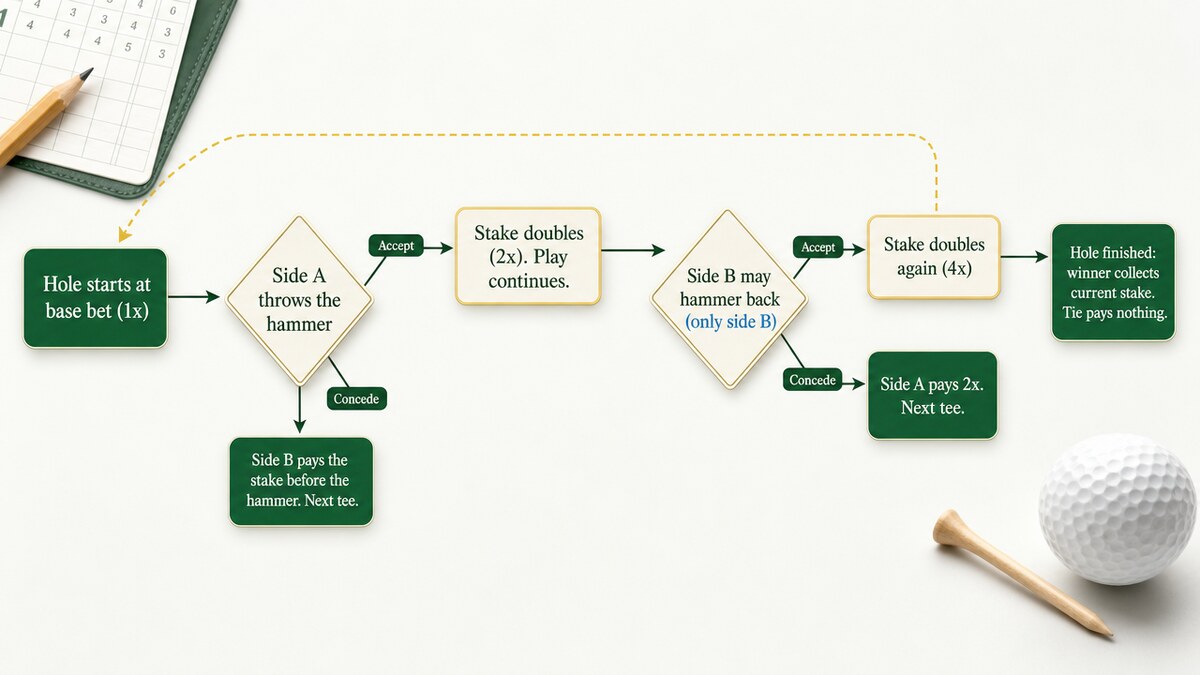
How stakes double and re-double
Each accepted hammer doubles the stake, so it grows faster than people expect.
| Accepted hammers on the hole | Multiplier | On a $1 base | On a $2 base |
|---|---|---|---|
| 0 | 1x | $1 | $2 |
| 1 | 2x | $2 | $4 |
| 2 | 4x | $4 | $8 |
| 3 | 8x | $8 | $16 |
| 4 | 16x | $16 | $32 |
Four accepted hammers turn a $2 hole into a $32 hole. That's the reason for caps, covered below.
A hole-by-hole example
Here is a $2-per-player game. Team A (players 1 and 2) plays Team B (players 3 and 4). The group agreed to a cap of three hammers per hole. The figures show what each Team A player wins or loses. Each Team B player has the opposite result.
| Hole | What happened | Final stake | Result for each A player | A running net |
|---|---|---|---|---|
| 1 | No hammer, A wins | $2 | +$2 | +$2 |
| 2 | B hammers ($4), A accepts. A hammers back ($8), B accepts. B wins | $8 | −$8 | −$6 |
| 3 | A hammers, B concedes at the pre-hammer stake | $2 | +$2 | −$4 |
| 4 | No hammer, tie | $0 | $0 | −$4 |
| 5 | B hammers ($4), A accepts, A wins | $4 | +$4 | $0 |
| 6 | A hammers ($4), B hammers back ($8), A concedes | $4 | −$4 | −$4 |
After six holes, players 1 and 2 are each down $4, and players 3 and 4 are each up $4. Note hole 6: A conceded after B's re-hammer, so A paid $4 (the stake before that hammer), not $8.
Cube and On the Spot
Cube (also called Shark). This version suits two players or two teams. Instead of either side hammering freely, one side holds the "cube," usually the side with the shorter drive on the hole. Only the holder can double. Once used, the cube passes to the other side, who then holds the only right to double back. Many groups play the front and back nines as separate cube bets, so a bad front nine doesn't bleed into the back.
On the Spot. One player per hole is "on the spot," rotating through the group the way the Wolf rotates. That player has to avoid posting the group's worst score. If they succeed, they collect from the others. If they fail, they pay. You can play it for points and convert at the end, or settle in cash hole by hole. It works for three, four or five players. Just agree on the rotation before you start.
Let It Ride and Closeout
Let It Ride. Each player earns points by score on each hole. A Stableford-style scale works well: 1 for bogey, 2 for par, 3 for birdie. After a hole, you either bank your points, which locks them in, or let them ride into the next hole, where they double if you score again. A double bogey wipes out whatever you were riding. Banked points are safe. The highest banked total wins.
Closeout. This is an add-on for match play. A match ends early when one side leads by more holes than remain.. With Closeout, you don't stop there. You play the remaining holes as a new match for half the original bet. The losing side gets a chance to win something back, and the people still in the cart have a reason to keep playing.
Murphy and Nicklaus call bets
These are one-off calls, not hole-long doubling games.
- Murphy. From off the green, such as the fringe, the rough or a bunker, you call "Murphy" before you play. You're betting you'll get the ball in the hole in the number of strokes the group agreed on, usually two. Make it and the group pays you. Miss and you pay them. Agree in advance where a Murphy can be called from.
- Nicklaus. This goes to the longest drive that actually counts. It has to finish in the fairway, or the player has to make par on the hole, depending on your version. The winner collects from the other players.
Using the Hammer on top of Wolf or Nassau
Avoid double-counting by deciding one thing first: does the hammer multiply points or dollars? Pick one and write it down.
With Wolf. Let the hammer multiply that hole's points. In Wolf, a Wolf and partner who win get 2 points each, and if they lose each defender gets 1. If the hole was hammered once and accepted, double those points before adding them to the totals. Settlement then runs normally at your per-point value, based on each player's distance from the group average. Wolf point values vary from group to group, so confirm yours before the round.
With a Nassau. Keep the Hammer as a separate per-hole bet running alongside it. A hammer shouldn't change who won the hole for front, back or overall. A press adds a new bet that runs from that hole on. A hammer doubles only the current hole. If you let a hammer multiply the Nassau bets and the presses, you've created a bet nobody priced. The Nassau is a format we have on our roadmap, along with Hammer and Closeout.
Set caps so friendly stakes stay friendly
Agree on caps on the first tee, before anyone is losing. Pick one or two:
- Hammers per hole. Two or three accepted hammers is plenty.
- Per-hole ceiling. For example, no hole worth more than 8x the base.
- Round ceiling. The most any player can lose on the day.
- Last-hole rule. Either no hammering on 18, or a single hammer only.
- Who can open. Some groups let only the side that's trailing in the match throw the first hammer on a hole.
Handicaps matter more when stakes double. Give strokes on hammered holes exactly as you would on any other hole. Consider capping each hole at net double bogey, a familiar Maximum Score approach, so one blow-up hole can't decide the day's money.
On the bigger picture, the USGA's current Rules of Amateur Status allow informal wagering as long as it doesn't lead to abuse of the Rules of Golf or the handicap rules. They describe acceptable wagering as bets where the players generally know each other, nobody is required to take part, and all the money won is put up by the players themselves.. This page is general information. Rules on wagering differ by place, so check with a qualified professional if you're unsure what applies to you.
Etiquette disputes to settle before the first tee
- Mid-swing hammers. Don't call while a player is over the ball or swinging. Golf etiquette already says no noise or movement while someone is preparing to play. Treat a hammer called during a swing as void.
- Ball in motion. Decide whether a hammer can be thrown while a shot is still rolling. Most groups say no. You hammer before you hit, or once everything has stopped.
- Answer time. The hammered side answers before the next shot is played. Silence counts as a concession or an acceptance, whichever you agreed. Pick one.
- Pace. Hammer talk shouldn't slow you down. Make the call, get the answer, and play.
How to settle a hammered round accurately
- Record every hole. Note the base stake, each hammer, whether it was accepted or conceded, and the winner. Don't rely on memory.
- Total each player's net. Use the stake that actually applied on each hole, and remember that a concession pays the stake before the last hammer.
- Check that it adds to zero. Every dollar one player wins, someone else loses. If the nets don't sum to zero, a hole was recorded wrong. Find it before anyone pays.
- Minimize payments. Net everything out, then have the fewest players pay the fewest people.
For the games Green Math already scores, which are Wolf, Nines and Las Vegas, step four is automatic. The settlement matrix shows who pays whom in the fewest transactions, and the round is saved so nobody has to reconstruct it later. Hammer isn't scored in the app yet, but your base game can be. Start a free round and let the math run itself.
Frequently asked questions
Can you hammer after a bad shot?
That depends on your group. Many groups only allow the side that's ahead on the hole to hammer, or ban hammering right after your own good shot. Agree on the rule before you tee off.
What does it cost to decline a hammer?
You lose the hole at the stake that applied before that hammer. If a $2 hole was hammered to $4 and you concede, you pay $2.
Do ties carry over in the Hammer?
Not in the standard game. A halved hole pays nothing, and the next hole starts at the base bet.
Does Green Math score the Hammer?
Not yet. Hammer is on our roadmap. Today, Green Math scores Wolf, Nines and Las Vegas, with full settlements.
How many hammers per hole is reasonable?
For a friendly game, two or three accepted hammers is a sensible cap. Beyond that, a single hole can swamp the rest of the round.